Every prospect has that season when people begin paying attention. For Milwaukee Brewers prospect Andrew Fischer, 2026 has become something much bigger than a breakout.
He’s putting together a season that belongs in the Minor League Baseball record book.
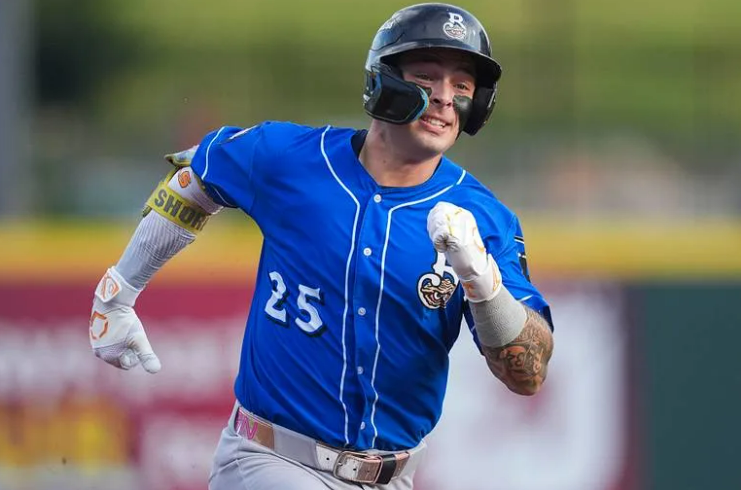
On September 10th, Fischer stepped to the plate for Double-A Biloxi in Pensacola and launched a solo home run to right field. It was his 47th home run of the season, breaking a tie with former National League MVP Ryan Howard for the most home runs by a Minor League player in a single season during the 21st century. Howard hit 46 between Double-A Reading and Triple-A Scranton/Wilkes-Barre in 2004. Fischer now stands alone.
And considering we’re talking about a record that has survived the careers of some pretty ridiculous power hitters over the last quarter-century, that alone would be enough to make Fischer’s season special.
But now I’m wondering just how far he can take this thing. Because Fischer isn’t merely chasing 50 anymore. He’s beginning to creep toward a Minor League record that has stood for more than half a century.
47 Home Runs—and Counting
Fischer enters play on September 11 hitting .272 with a .411 on-base percentage, 47 home runs, 113 RBIs and a 1.067 OPS in 123 games between High-A Wisconsin and Double-A Biloxi. He’s the only Minor League hitter to reach 40 home runs this season, and his 47th moved him into fifth place among all Minor League hitters during the modern era, which dates to 1963.
The names immediately ahead of him give you an idea of the territory we’re entering.
Tony Solaita hit 49 for High Point-Thomasville in 1968. Ron Kittle reached 50 with Triple-A Edmonton in 1982. Gorman Thomas blasted 51 for Sacramento in 1974. And sitting at the very top is Bill McNulty, who hit 55 home runs for Triple-A Sacramento in 1974.
That leaves Fischer eight home runs away from tying McNulty.
With the Minor League calendar running out, reaching 55 is obviously a long shot. But 50? That’s suddenly very much in play. And considering Fischer’s recent pace, I’m not ready to completely dismiss anything.
His 47th homer wasn’t some isolated blast after a prolonged drought. Fischer has been absolutely scorching the baseball down the stretch. He hit four homers during Biloxi’s previous series against Birmingham, including two on Saturday to reach 46 and tie Howard. Those two blasts gave him eight home runs in nine games at the time.
This isn’t a player limping toward a record because of an enormous first half.
He’s accelerating toward the finish.
The Modern Record Comes With a Pretty Significant Asterisk
If Fischer somehow makes a serious run at 55, there’s another wrinkle that makes this chase fascinating.
Bill McNulty’s record is legitimate. He hit 55 home runs in 1974, and those home runs count just as much today as they did then.
But you have to understand where he was playing.
The 1974 Sacramento Solons, who were Milwaukee’s Triple-A affiliate, played at Hughes Stadium on the campus of Sacramento City College. The facility was primarily designed for football and track, and converting it into a baseball stadium created one of the most ridiculous ballpark configurations professional baseball has ever seen.
Dead center was 390 feet. Right field was 300. Left field was just 233 feet from home plate.
For comparison, Major League Baseball’s current recommended minimum distance down the foul lines is 320 feet. Minor League Baseball actually had a 250-foot minimum at the time, but Sacramento received a one-year waiver because there simply wasn’t enough room to configure the field differently. A 40-foot-high screen was erected in left, but it didn’t exactly prevent Hughes Stadium from becoming a home run factory.
Calling it hitter-friendly would be an understatement.
Sacramento hit an absurd 305 home runs as a team that season, with 250 coming at home. Add the visiting teams and Hughes Stadium surrendered 491 home runs in 1974. McNulty hit 44 of his 55 homers at home and only 11 on the road. His teammate Gorman Thomas hit 51, which remains the second-highest total of the modern Minor League era. Three other Sacramento hitters finished with at least 32.
Even the players knew how ridiculous it was.
McNulty himself acknowledged during that season that his home run total was inflated by the park and estimated that he probably deserved somewhere around 33 or 34 under more normal circumstances. Salt Lake City manager Norm Sherry described Hughes Stadium as a “Little League park with a big screen.”
That context makes what Fischer is doing 52 years later even more impressive.
He’s not playing half his games with a 233-foot porch in left field. He’s accumulated his 47 home runs across two levels and different ballparks while facing increasingly advanced pitching.
So yes, McNulty’s 55 remains the record. Fischer needs eight more just to tie it, and with so little season remaining, the math isn’t exactly in his favor. But if we’re comparing the quality of these power seasons rather than simply looking at the final number, Fischer has already made one heck of an argument.
From College Star to Historic Season in Barely a Year
Perhaps the craziest part of this entire story is that Fischer was playing college baseball about 15 months ago.
Milwaukee selected him 20th overall in the 2025 MLB Draft after his junior season at Tennessee, where he led the SEC with 25 home runs. Before Tennessee, Fischer had played at Duke and Ole Miss, establishing himself as one of the more accomplished power hitters in his draft class.
Now, in his first full professional season, the 22-year-old has almost doubled that 25-homer college total.
Fischer began 2026 with High-A Wisconsin and hit 20 home runs in 54 games before Milwaukee promoted him to Double-A Biloxi in June. Rather than being exposed by the better pitching, his power production somehow increased.
His 47th homer was his 27th in just 69 Double-A games.
That translates to roughly one home run every 2.6 games at Double-A.
Power is obviously the calling card, but Fischer hasn’t simply been selling out for home runs while contributing nothing else offensively. That .411 on-base percentage jumps off the page almost as much as the homer total. He has demonstrated an ability to draw walks and reach base at an elite clip while producing enormous damage when pitchers actually come into the zone. There is swing-and-miss in the profile, and that’s going to be one of the biggest questions as he moves closer to Milwaukee, but the combination of power and on-base ability gives him a fascinating offensive ceiling. Baseball America describes him as possessing plus-plus game power while noting that the swing-and-miss remains the primary concern.
It’s also worth remembering what organization we’re talking about.
The Brewers have become exceptionally good at developing young players and finding ways to get them to Milwaukee quickly when they believe they’re ready.
Which leads me to a question that would’ve sounded completely ridiculous a few months ago.
Could Andrew Fischer actually help the Brewers this October?
Could Milwaukee Pull a Chase DeLauter?
I’m not predicting this happens. In fact, the conventional expectation remains that Fischer makes his Major League debut sometime in 2027.
But baseball gave us a fascinating precedent just last October.
Cleveland entered the 2025 postseason with Chase DeLauter still waiting to make his Major League debut. Then the Guardians put him on their Wild Card Series roster. DeLauter made his Major League debut in the postseason, becoming only the sixth player in MLB history to debut in the playoffs and the first position player to start his debut in a postseason game. MLB’s story on Chase DeLauter’s historic postseason debut.
Could Milwaukee consider something similarly aggressive with Fischer?
There are obviously major differences between the situations, and there’s a significant jump from Double-A pitching to trying to hit Major League arms in October. Fischer also isn’t currently on Milwaukee’s 40-man roster, and postseason eligibility rules would have to factor into any potential decision.
Still, the Brewers are 91-56, comfortably leading the NL Central and closing in on another postseason berth. Their magic number to clinch the division was down to five entering Thursday. This is a team with legitimate October aspirations, not one simply waiting for next season. Plus, the Brewers are not a team that hits a lot of home runs, so adding Fischer to their lineup would be a massive improvement in that department.
If you’re Milwaukee and Fischer continues hitting baseballs over fences at a historic rate, at what point do you at least have the conversation?
Maybe the answer is that you don’t. Maybe the Brewers allow him to finish this remarkable season, send him home, give him a full offseason and let him compete for a Major League opportunity in 2027. There’s a very reasonable argument that his long-term development matters more than chasing the possibility of a few October at-bats.
But there’s also something tantalizing about having a left-handed hitter with 47 home runs and a 1.067 OPS sitting in your organization while you’re preparing for the postseason.
Baseball has taught us never to completely dismiss the unconventional.
How Far Can He Take This?
The postseason question is fun, but I don’t want it to overshadow what Fischer has already accomplished.
Ryan Howard’s 46-home run season stood as the 21st-century Minor League standard for more than two decades. Howard went on to become one of the most prolific power hitters of his generation, blasting 58 home runs two years later for Philadelphia and eventually finishing his career with 382.
Fischer just passed him.
He’s now two homers away from Solaita, three away from becoming the first Minor Leaguer since Ron Kittle in 1982 to reach 50, four away from tying Gorman Thomas and eight away from McNulty’s modern-era record.
Maybe he runs out of games before he gets anywhere near 55. He probably will.
That shouldn’t diminish this season one bit.
There is a tendency with prospects to always look toward the next thing. When will he get promoted? When will he reach Triple-A? When will he make his Major League debut? Where will he rank on the next Top 100 list? What kind of Major Leaguer will he eventually become?
Those are worthwhile questions, and I’ll certainly be asking them about Fischer.
But sometimes it’s worth appreciating what a prospect is doing right now.
Andrew Fischer is 22 years old. He’s barely a year removed from college baseball. He’s already reached Double-A. He’s hitting .272 with a .411 on-base percentage and an OPS north of 1.000. He’s driven in 113 runs.
And he’s hit 47 home runs.
No Minor League player in the 21st century has ever hit more.
Whether Milwaukee decides to get creative and give Fischer an opportunity in October or waits until 2027, we’ll find out soon enough. Whether he can somehow chase down one of the strangest records in Minor League history is another question entirely.
But one thing isn’t really up for debate anymore.
Andrew Fischer’s 2026 season has gone from an impressive prospect breakout to something genuinely historic—and it’s time we start treating it that way.
 Empire Sports Talk
Leave a comment