
There are certain players who become so synonymous with an era of baseball that it’s difficult to imagine the game without them. For me, Justin Verlander is one of those players.
For more than two decades, Verlander was one of the constants of Major League Baseball. The high leg kick. The overpowering fastball. The almost ridiculous ability to find another gear in the seventh or eighth inning when most starting pitchers were beginning to fade. The intensity. The durability. The strikeouts. For much of my life watching baseball, Justin Verlander was simply there, taking the ball every fifth day and usually doing something remarkable with it.
On Saturday, he took the ball one final time. And somehow, after a final season that went almost completely wrong, baseball gave him an ending that couldn’t have been scripted any better.
One Last Start Where It All Began
Verlander knew 2026 would be his final season, and there was every reason to hope it would become a year-long farewell tour. Instead, his body finally began telling him what hitters had struggled to do for 21 seasons: enough.
His return to Detroit lasted just one start before hip and hamstring injuries essentially wiped out his season. Verlander hadn’t pitched in a Major League game since March 30 and, by his own admission, wasn’t sure he’d physically be able to make it back at all.
But there was one thing he desperately wanted. One more start in Detroit.
So the 43-year-old fought through the injuries, skipped much of the normal rehabilitation process and made it back for September 26. No rehab start. Just grit. Vintage Verlander. His final opponent would be the Pittsburgh Pirates, and his final mound would be the same one where he had begun building his legend more than two decades earlier.
Tigers broadcaster Jason Benetti captured the moment beautifully as Verlander prepared to throw his first pitch:
“When Justin Verlander first took this mound in 2005, all he wanted was for his dream to become reality. And now for one day, he simply wants reality to be something of a dream.”
That’s exactly what Saturday became.
Verlander’s wife, children, parents and brother were there. Comerica Park was packed with 41,377 fans, many wearing Verlander jerseys that spanned multiple generations of Tigers baseball. Some were undoubtedly the same people who watched a 22-year-old Verlander arrive in Detroit in 2005 wondering what he might become.
Twenty-one years later, they already knew the answer. They were there to say thank you.
One of the Greatest to Ever Do It
It’s easy to become numb to greatness when you watch it for long enough, and Verlander gave us an awfully long time to get used to his.
He retires with 266 wins, a 3.33 ERA and 3,560 strikeouts, the eighth-most strikeouts in Major League history. He made 10 All-Star teams, won three Cy Young Awards and was the 2011 American League MVP after winning the pitching Triple Crown. He threw three no-hitters and won two World Series championships with Houston. His 244 postseason strikeouts remain the Major League record.
But the numbers only tell part of what made Verlander special. What I’ll always remember is the way he pitched. Verlander always reminded me of a modern-day Nolan Ryan. There was obviously the power and longevity, but more than anything, it was their shared willingness to keep throwing until somebody practically took the baseball away from them.
Verlander became famous for getting stronger as games progressed. He could be sitting 93 or 94 mph early, then suddenly reach back for 98 or 99 in the seventh inning. There was always something left in the tank. Hitters could spend three trips through the lineup trying to catch up to him, only to discover that the version standing on the mound late in the game might be even more difficult to hit than the one they faced in the first.
Even at 43 years old, after six months without pitching in a Major League game, that competitiveness hadn’t disappeared.
Verlander went 5 1/3 innings, throwing 91 pitches and striking out six. He even reached 95 mph again. Pittsburgh got him for two solo home runs, but otherwise, vintage Verlander made one final appearance.
And because there would be no next start, Tigers manager A.J. Hinch was willing to let his old ace empty whatever remained in the tank.
“There’s no script,” Verlander had said beforehand. “I want to go as long as I can.”
He did.
Then it was time.
One Final Mound Visit
Verlander retired Brandon Lowe to begin the sixth inning, recording the final out of his career.
Hinch emerged from the Detroit dugout.
Anyone who has watched baseball knew what was coming. The manager would make the slow walk toward the mound, Verlander would hand him the baseball and Comerica Park would rise for one final ovation.
Except Hinch didn’t immediately walk toward his pitcher. He turned toward the stands. Then Genevieve Verlander came running onto the field.
Verlander’s seven-year-old daughter sprinted toward the mound and wrapped her arms around her father. Verlander had no idea it was coming. The man who had spent more than two decades maintaining his composure in some of baseball’s most pressure-filled moments couldn’t hold it together anymore.
He sobbed.
Later, Verlander explained that as he held his daughter, he wanted to make sure she understood the tears weren’t because something was wrong.
“I’m just so happy.”
That might be my favorite part of the entire day.
For 21 seasons, the mound had represented work. Competition. Preparation. Pressure. It was the place where Verlander had chased championships, no-hitters, strikeout records and greatness.
For his final moments there, none of that mattered. He was just Dad.
Hinch eventually took the baseball and embraced him. Verlander’s teammates surrounded him. The crowd chanted “J.V.” as he began walking away from a Major League mound for the final time.
Then came an image I don’t think I’ll forget.
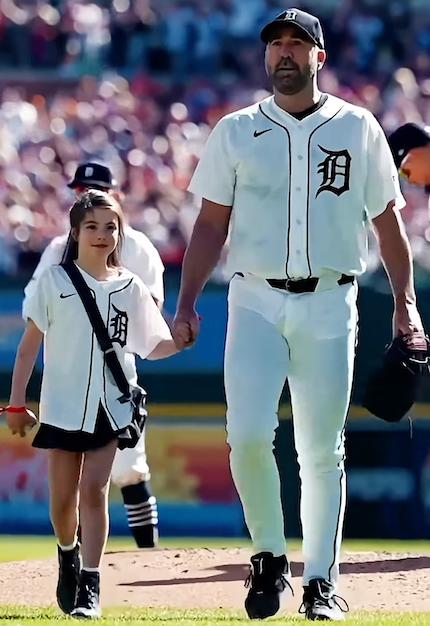
Verlander walked toward the dugout hand-in-hand with Genevieve. His wife, Kate Upton, and the rest of his family joined him near the field. Together, the Verlander family descended the dugout steps and disappeared from view.
A baseball career that began more than two decades earlier ended with the people who had sacrificed alongside him walking away with him.
Verlander later said he couldn’t imagine a better ending. Neither can I.
Except baseball wasn’t finished yet.
“The Tigers Do It for JV!”
When Verlander left, Detroit was trailing 2-0.
By the ninth inning, Pittsburgh led 3-1. The Tigers were down to their final out when their young lineup mounted one last rally. Max Clark and Hao-Yu Lee helped keep the game alive, bringing ROOKIE Eduardo Valencia to the plate with Detroit now trailing by one.
Valencia launched the ball over the right-field wall. Walk-off home run. Tigers win, 4-3. Comerica Park erupted.
After the game, Hinch summed it up perfectly: “There’s no way Justin Verlander gets a loss in his last game.”
Apparently, the baseball gods agreed.
How Can You Not Be Romantic About Baseball?
Sitting there watching one of my favorite pitchers of this era say goodbye, I kept coming back to that famous question:
How can you not be romantic about baseball?
I know the phrase gets thrown around a lot, sometimes to the point of becoming a cliché. But every once in a while, baseball gives us a day that reminds us exactly why the saying became so popular in the first place.
Saturday was one of those days.
There was Verlander, back where it all began, pitching in front of the people who watched him become a superstar. There was one last glimpse of the pitcher we remembered, reaching back for 95 mph and striking out six despite essentially missing an entire season.
Then there was Genevieve.
That’s where the baseball accomplishments suddenly became secondary. Three Cy Young Awards, 3,560 strikeouts, three no-hitters, an MVP, two championships—all incredible. All permanent pieces of baseball history.
But careers eventually become memories, and Saturday gave Verlander one more that had nothing to do with a statistic.
His daughter running toward him. The embrace on the mound. The tears. The long walk toward the dugout, hand-in-hand. His family waiting for him. And then all of them disappearing down the steps together.
Twenty-one seasons distilled into one beautiful image.
And just when you thought the movie had ended, Eduardo Valencia provided the final sweeping stroke of the masterpiece with a two-out, walk-off home run.
Justin Verlander spent more than two decades giving baseball fans unforgettable moments. He overwhelmed hitters, threw no-hitters, won championships, chased history and built a résumé that will eventually carry him to Cooperstown.
But I’m not sure any of those moments captured the full journey quite like his last one did.
A legendary pitcher walked onto the mound one final time – and his team made sure he left a winner.
Dang it, I love this game.


Leave a comment