
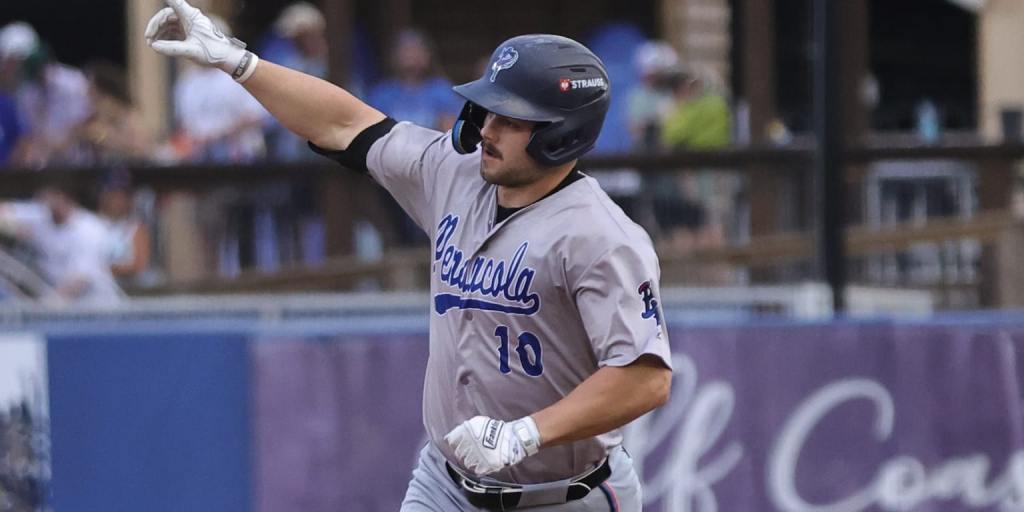
If you’re familiar with this site over the last six months or so, you know I love talking about prospects, so this story jumped off the page when I saw it.
Earlier this week, Baseball America highlighted a pretty remarkable statistic involving Miami Marlins outfield prospect Brandon Compton. According to Baseball America, at the beginning of September, Compton was the only player in Minor League Baseball with at least 30 home runs, 20 stolen bases and a batting average above .275. At the time, he was hitting .277/.423/.599 with 33 homers and 22 stolen bases.
Those numbers were already enough to get my attention.
Then I went digging a little deeper, and somehow Compton’s season has become even more interesting since Baseball America brought him to my attention.
Entering play on September 7, the 22-year-old has now pushed his season totals to 34 home runs, 27 stolen bases and a .279 average, accompanied by a .422 on-base percentage and 1.022 OPS. He has 96 RBIs in 112 games across three levels of Miami’s system.
Oh, and the Marlins just promoted him to Triple-A. Naturally, he homered in his first game.
Who Is Brandon Compton?
Compton isn’t one of those teenage international prospects we’ve been hearing about for five years. His rise has happened remarkably quickly.
Miami selected the Arizona State outfielder with the 46th overall pick in the second round of the 2025 MLB Draft, signing him for $2 million. Compton had already shown considerable offensive upside in college, winning Pac-12 Freshman of the Year in 2024 after hitting .355/.427/.661 with 14 home runs. His production dipped somewhat during his draft-eligible season, but there was never much question about whether the power was legitimate.
In fact, Compton put on one of the more impressive power displays in MLB Draft Combine history. The 6-foot-1, 225-pound left-handed hitter produced the three hardest exit velocities recorded during the event’s first three years, helping alleviate some concerns after his uneven final season at Arizona State. MLB Pipeline currently gives Compton a 55 power grade, while Baseball America is even more bullish with a 60.
The power was always supposed to be there.
What probably wasn’t expected was for Compton to turn himself into a legitimate power-speed threat this quickly.
He stole eight bases in just 27 games during his professional debut last season. In 2026, that number has climbed to 27, giving Compton the kind of statistical profile you don’t normally associate with a 225-pound corner outfielder.
That combination is exactly why the Baseball America statistic stood out so much. Plenty of minor leaguers hit for power. Plenty can steal 20 bases. Others can maintain a strong batting average. Finding somebody doing all three at the same time is considerably more difficult.
Right now, Compton is doing all of it.
This Season Didn’t Start Like This
Here’s perhaps the craziest part of Compton’s breakout: for the first two months, he wasn’t particularly good.
A hamate injury during Spring Training disrupted his preparation for his first full professional season, and the effects were pretty obvious once the games began. From April 2 through June 3, Compton hit just .180/.415/.302 with three home runs in 42 games for High-A Beloit. The extremely high on-base percentage showed that he was still controlling the strike zone and drawing walks, but the impact simply wasn’t there.
Then something clicked.
Compton began finding his timing in June and eventually played himself into a promotion to Double-A Pensacola. That’s when his season went from encouraging to downright ridiculous.
In 50 games with the Blue Wahoos, Compton hit .332/.421/.759 with 21 home runs, 15 doubles and 54 RBIs. He slugged 12 homers in July alone, establishing a Pensacola single-month franchise record and producing the most home runs by a Marlins Double-A player in a month since at least 2005.
He didn’t cool down in August, either.
According to Baseball America, Compton hit .333/.426/.727 during the month with eight home runs, 13 doubles and 27 RBIs. He produced 22 extra-base hits in August alone. Baseball America also measured his 90th-percentile exit velocity at 109.9 mph, another indication that this isn’t simply a player taking advantage of minor-league pitching with unsustainable results. When Compton gets the barrel to the baseball, he hits it extremely hard.
At that point, Miami had seen enough.
Triple-A was next.
So Much for Needing Time to Adjust
Compton was promoted to Jacksonville at the beginning of September, giving him one final challenge before the Major Leagues.
His introduction to Triple-A pitching lasted all of one game before he went deep.
Compton homered in his Triple-A debut on September 2, sending a 104-mph shot 365 feet to right field. And through his first six games at the level entering September 7, he’s hitting .409 with a .500 on-base percentage, two home runs and five stolen bases.
Yes, we’re talking about an extremely small sample size. Six Triple-A games tell us very little about what kind of Major League player Compton will eventually become.
But considering everything that came before it, it’s another encouraging development.
Compton struggled early in High-A, adjusted and earned a promotion. Then he got better after reaching Double-A. Now Miami has pushed him to Triple-A near the end of his first full professional season, and he has once again responded immediately.
That’s what you want to see from a prospect.
There Is One BIG Question
As exciting as the numbers are, there is a reason Compton isn’t currently sitting near the top of every Top 100 prospects list.
He swings and misses. A lot.
Compton has struck out 171 times this season, and his overall contact rate has been just 57 percent. MLB Pipeline noted that his plate appearances have ended in one of the traditional “three true outcomes”—a home run, walk or strikeout—nearly 60 percent of the time. For some perspective, Joey Gallo’s 2021 season holds the highest three-true-outcomes rate for a qualified Major League hitter over a full season at 58.8 percent.
That comparison tells you both what makes Compton exciting and what makes him risky.
There are some encouraging signs underneath those strikeout totals. His strikeout rate dropped to 26.9 percent in August after sitting above 35 percent during each of the previous three months. More importantly, Compton doesn’t simply swing at everything. His chase rate is just 23 percent, a figure MLB Pipeline noted would rank among the best in the Majors.
That’s a fascinating combination. Compton recognizes balls and strikes relatively well, draws a ton of walks and absolutely destroys the baseball when he connects. The problem is actually making contact when he decides to swing. Sliders and changeups have been particularly problematic, and his numbers against left-handed pitching remain concerning.
If you’re looking for the developmental question that could ultimately determine whether Compton becomes an everyday Major League player or simply an interesting minor-league slugger, that’s it.
He doesn’t need to become Luis Arraez. With this much power and this kind of plate discipline, he doesn’t even need to become an above-average contact hitter. But he has to make enough contact to allow everything else to play.
If he does?
Now we’re talking about a really intriguing player.
Miami May Have Something Here
What makes Compton’s breakout even more impressive to me is how quickly this has all happened.
The Marlins drafted him barely more than a year ago. He’s already gone from High-A to Double-A to Triple-A, and he’s done it while putting together one of the most unusual offensive seasons anywhere in the minor leagues.
Entering September 7, we’re looking at a 22-year-old with 34 homers, 27 stolen bases, 25 doubles, 96 RBIs and a 1.022 OPS. He’s walking at an extraordinary rate, hitting the baseball exceptionally hard and has already reached Triple-A during his first full professional season.
Baseball America currently ranks Compton as Miami’s No. 11 prospect, while MLB Pipeline’s most recent ranking has him at No. 13. Those rankings could look considerably different the next time these lists are updated if Compton continues doing this.
There is still plenty to work on, and I actually think that makes this prospect more interesting rather than less. We aren’t looking at a polished player without any obvious weaknesses. Compton has one enormous question surrounding his hit tool, and Triple-A pitching should give us a much better idea of whether he can answer it.
But you can’t teach this kind of raw power. You certainly don’t see many players combining it with 25-plus stolen bases. And the fact that Compton has continued improving as the competition has gotten better is difficult to ignore.
That’s why this story jumped out at me when Baseball America brought that bizarre 30-homer, 20-steal statistic to my attention. The more I looked into Brandon Compton, the more I found myself wondering why we aren’t talking about him more.
Maybe that’s about to change.
Thirty-four home runs. Twenty-seven stolen bases. A .279 average. Triple-A at 22 years old.
For a player who began June hitting .180, that’s one heck of a turnaround.
Brandon Compton may not be one of baseball’s household-name prospects yet, but if he keeps doing this, he won’t stay under the radar much longer.
 Empire Sports Talk
Leave a comment