
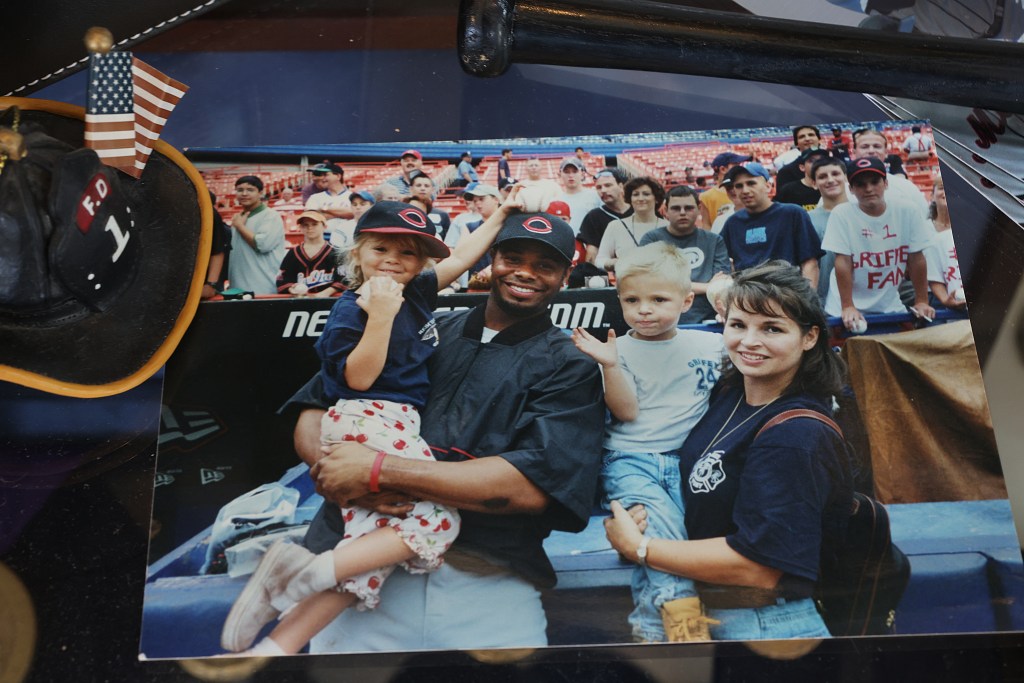
Every year, I make a special effort to remember September 11.
Twenty-five years later, there are stories from that day and the weeks that followed that remain difficult to comprehend. There are stories of unimaginable loss, but also extraordinary courage, compassion and humanity. As time passes, I think telling those stories becomes even more important. They remind us that the nearly 3,000 people killed on September 11, 2001 were not simply names inscribed on a memorial. They were husbands and wives, fathers and mothers, sons and daughters, friends and coworkers. They had jobs, hobbies, favorite songs, favorite teams and favorite baseball players.
This year, one of those stories particularly caught my attention because of a small connection I immediately felt to a man I never knew.
His name was Kenneth “Kenny” Marino, an FDNY firefighter with Manhattan’s elite Rescue 1 company. Marino loved baseball. He loved the Mets, followed the Mariners and even had something of a shrine in his home dedicated to his favorite player.
That player was Ken Griffey Jr.
If you’ve followed my work for any length of time, you probably know why that immediately grabbed me. Griffey is my favorite baseball player of all time, too. Like so many kids who grew up watching baseball in his era, I was captivated by the backwards hat, the effortless swing and the way “The Kid” seemed to make everything about baseball look cool.
For Kenny Marino, that connection ran much deeper. He had followed Griffey for years. His coworkers knew about his love of baseball and his admiration for Junior.
Then came September 11. And through circumstances nobody ever would have wanted, Griffey became connected to the Marino family forever.
A Firefighter Through and Through
Long before September 11 made Kenny Marino one of the names America would mourn, firefighting was simply part of who he was.
His wife, Katrina, told a wonderful story to the Boston Globe ahead of the 25th anniversary that perfectly illustrates it. On their first date in 1994, Kenny suddenly began rushing her out of his apartment. Katrina had no idea what was happening. They jumped into his car and sped away, eventually arriving at a burning house. Kenny opened his trunk, grabbed his firefighting gear and went to work. He had been a volunteer firefighter in Long Beach before eventually joining the FDNY.
As Katrina put it, “It was in his blood.”
By 2001, Marino was 40 years old, a husband and the father of two very young children, Kristin and Tyler. He was also a member of Rescue 1, one of the FDNY’s specialized rescue companies.
On the morning of September 11, Katrina and the children happened to stop at the Rescue 1 firehouse. Kenny had worked the previous day and slept there overnight. Katrina needed to switch vehicles with him before taking the children to appointments in the city.
It became their final morning together.
Kenny sat his children in the fire truck for a few minutes. Before Katrina drove away, he walked around the vehicle and kissed each child in their safety seat. They left around 8:15 that morning. American Airlines Flight 11 struck the North Tower at 8:46.
Katrina and the children were still in Manhattan when the plane flew overhead. Then came the alarms. Then the fire trucks.
Katrina told the children, “That’s Daddy!”
She was right. Rescue 1 responded to the World Trade Center. Eleven members of the company were killed that morning, including Kenny Marino. His remains have never been identified. His battered Rescue 1 helmet and Halligan bar were eventually recovered from Ground Zero.
He left behind Katrina and two children who were barely old enough to understand what had happened. And somewhere in the Marino home was that little shrine to Ken Griffey Jr.
“If Ken Griffey Jr. Could Hit an Extra Home Run for Kenny…”
Major League Baseball stopped playing after the attacks. Games were postponed for six days, and rightly so. Nobody quite knew when baseball should return—or whether playing baseball mattered at all in a moment like that.
Katrina Marino was dealing with something infinitely larger. Her husband was missing, and with every passing day the possibility that he might somehow come home grew more remote. One night, looking for some way to feel connected to Kenny, Katrina sat down at his desktop computer.
She hadn’t even used it before. She sent an email to the Cincinnati Reds.
Her request was remarkably simple. Kenny’s favorite baseball player was Ken Griffey Jr. Maybe, she wondered, Junior could hit one more home run for him.
“My husband, Kenny Marino, a Rescue 1 firefighter, is missing. Ken Griffey Jr. was his favorite player. If Ken Griffey Jr. could hit an extra home run for Kenny, I know he will be looking down with a big smile.”
There is something about that request that gets me.
Katrina wasn’t asking Griffey to fix anything. He couldn’t. Nobody could. She wasn’t asking for money or publicity. She was simply trying to reach across the enormous void that had suddenly entered her life and find something that still connected her to her husband.
Baseball. Her husband’s favorite player. One more home run.
The email eventually reached Reds media relations director Rob Butcher on September 25. Cincinnati was in Philadelphia preparing to play the Phillies at Veterans Stadium. Butcher printed the message and took it into the clubhouse.
He handed it to Griffey. A few hours later, Junior stepped into the batter’s box in the fourth inning against Phillies starter Dave Coggin.
And because sometimes baseball produces moments that would be rejected from a movie script for being too perfect, Ken Griffey Jr. hit a home run.
His 21st of the season. One more for Kenny.
Griffey Understood What the Home Run Meant—and What It Didn’t
The easiest thing to do with a story like this is romanticize the home run itself. Griffey didn’t. His reaction afterward might be the most meaningful part of the entire story.
He talked about being grateful that he could do something for someone who considered him a favorite player and that he was happy to give Katrina a reason to smile. But then Griffey immediately put his own gesture into perspective.
“This guy lost his life to save others.”
That’s the heart of this story.
Griffey understood that a home run couldn’t replace Kenny Marino. It couldn’t bring a father home to Kristin and Tyler. It couldn’t erase what Katrina had experienced or repair what had happened to thousands of families.
It was a baseball. A bat. A swing. A home run. But sometimes something small can still matter enormously.
Griffey autographed the bat he used and sent it to Katrina, along with a recording of the home run and newspaper coverage from Philadelphia.
He could have stopped there. It already would have been a wonderful gesture. He didn’t.
One Home Run Became a Relationship
When the Reds visited Shea Stadium in 2002, Griffey invited Katrina, Kristin and Tyler to meet him.
The children were still incredibly young. Kristin had been just 2½ when her father died and Tyler only 1½. Yet when they met Griffey, something clicked immediately. They climbed all over him and hugged him like someone they had known forever.
Rob Butcher remembered being slightly terrified watching it unfold before realizing Griffey loved every second of it. Griffey had children of his own. He understood.
That first meeting wasn’t the last. Over the years, Griffey continued inviting the Marinos to games. On one September 11 in Cincinnati, Tyler was invited to throw a ceremonial first pitch. When Griffey was inducted into the Baseball Hall of Fame in 2016, the Marino family attended Cooperstown as his guests. Griffey gave Tyler the cap he had worn during much of his induction day.
Think about the span of time represented there. Tyler was 1½ when his father was killed. By Griffey’s Hall of Fame induction, he was 16. The little boy who lost his dad before he could really know him had grown up with his father’s favorite baseball player remaining a presence in his family’s life.
Griffey didn’t have to do that.
The cameras weren’t following every interaction. There wasn’t a marketing campaign built around it. A request for one home run in September 2001 became a relationship that stretched across years.
For Katrina, those experiences became part of how the family learned to live with something that never truly goes away. She described their approach beautifully in reflecting on the past quarter-century:
“We choose to create better memories.”
Not replacement memories. Better memories. There is an important distinction.
Nothing could replace Kenny. The goal wasn’t to move beyond him or somehow make September 11 hurt less. It was to allow happiness to exist alongside the grief. Griffey, baseball and the experiences that came from that extraordinary home run gave the Marino family new memories to place beside the painful ones.
And somehow, 25 years later, the story had one more chapter left.
A Tap on the Shoulder
A couple of years ago, Kristin Marino was having dinner in Orlando with her future husband. By then she was an adult, living a life her father never had the opportunity to see.
According to Katrina, Kristin had spent days praying for some kind of sign from her dad. While sitting at dinner, she felt someone tap her on the shoulder. She turned around. Ken Griffey Jr.
There had been no arrangement. No planned reunion. Griffey simply happened to be there.
For Kristin, the meaning was immediate.
“It was such a God moment,” she later said. “I’m still blown away!”
Twenty-five years after September 11, the Marino family still has a photograph of Griffey visiting the 9/11 Memorial. In it, Junior is pointing toward a name etched into the memorial:
Kenneth Joseph Marino.
In a recent interview for the MLB Network documentary “When America Took The Field” about the 25th anniversary of the day that claimed her father’s life and the lives of so many others, Kristin Marino shared that when she was younger, her and her brother didn’t even realize who Griffey was, they just thought he was one of their uncles. She also shared that she recently got married, but didn’t invite Griffey because she didn’t want to bother him or make him feel obligated to come.
The producers of the documentary played that clip for Griffey, and without hesitation, the MLB superstar replied, “I would’ve been there…I would have cleared my schedule.”
The baseball player Kenny Marino loved never forgot him or his family.
Neither should we.
When Baseball Didn’t Know If It Mattered
I’ve always believed baseball is more than a game, but the weeks after September 11 demonstrated that in ways a box score never could.
Initially, baseball didn’t know what its role was supposed to be. Frankly, nobody did.
How do you play a game when thousands of people have just died? How do you celebrate a home run when families are waiting desperately for news about missing loved ones? How can winning and losing possibly matter?
For six days, Major League Baseball didn’t play. When players did return, some wondered whether they should be there at all.
But baseball’s contribution to the country during those weeks wasn’t really about the games. Before the Mets returned to the field, Shea Stadium became a staging area for relief supplies headed toward Ground Zero. Bobby Valentine, Mets players, employees, family members and volunteers helped organize medicine, food, blankets and whatever else was needed. Yankees players visited hospitals and the Armory, where families waited desperately for information about loved ones.
They weren’t there as athletes. They were New Yorkers asking the same question millions of Americans were asking:
How can we help?
Sometimes the answer was unloading a truck. Sometimes it was sitting beside somebody who needed to talk. Sometimes it was giving somebody a hug. And sometimes, eventually, it was playing baseball.
It Was Okay to Smile Again
On September 21, ten days after the attacks, professional sports returned to New York City when the Mets hosted the Atlanta Braves at Shea Stadium.
I’ve written about that night before because I think it remains one of the most powerful examples of what sports can mean when the game itself becomes secondary.
More than 41,000 people entered Shea carrying emotions far heavier than anything happening on the field. The Mets trailed 2-1 in the eighth inning when Mike Piazza came to the plate against Steve Karsay.
Piazza drove the ball over the wall in left-center.
Mets 3, Braves 2.
Shea Stadium erupted.
The importance wasn’t that New York had taken the lead in a September baseball game. It was what happened in those stands.
People smiled. People screamed. People hugged.
For a few seconds, thousands of people who had spent ten days living through grief, fear and uncertainty were allowed to experience something that had felt almost inappropriate since September 11 – joy.
The pain didn’t disappear when Piazza’s baseball cleared the fence. But for a moment, people were reminded that feeling happiness again wasn’t disrespectful to those they had lost. It was part of continuing to live.
Baseball Kept Finding Ways to Help
There were moments like that throughout the weeks that followed.
Ten-year-old Brielle Saracini lost her father, Captain Victor Saracini, when United Airlines Flight 175 was hijacked and flown into the South Tower. Three days later, Brielle wrote a letter to her favorite player, Derek Jeter. She told him about her father and about her dream of meeting him.
Jeter received it and acted quickly. Later that September, he invited Brielle and her family to Yankee Stadium, where she met him and the team.
In Chicago, Sammy Sosa returned to Wrigley Field and, after homering on September 27, carried an American flag around the bases. Later, he ran into the outfield waving it as the crowd roared.
Then came October.
The Yankees made an emotional run to the World Series, bringing the Fall Classic back to New York seven weeks after the attacks. Before Game 3, President George W. Bush walked onto the field at Yankee Stadium wearing an FDNY jacket. With the country watching and the stadium chanting “U-S-A,” he stood on the mound and threw a strike. No political division, just American strength.
Different players. Different cities. Different moments.
But they all seemed to answer the same question baseball had wrestled with in those first awful days.
What good can a game possibly do right now?
Quite a lot, as it turned out.
More Than a Game
Baseball couldn’t rebuild the World Trade Center.
It couldn’t bring Kenny Marino home. It couldn’t give Kristin and Tyler their father back. It couldn’t return Victor Saracini to Brielle. It couldn’t undo the grief carried by thousands of families or erase the images that an entire generation of Americans will never forget.
Nobody should pretend otherwise. But healing isn’t always about fixing something. Some things cannot be fixed. Sometimes healing is simply finding enough light to make it through another day.
Baseball provided some of that light.
It gave New Yorkers somewhere to gather. It gave strangers something familiar to talk about. It gave children heroes to reach out to when their worlds suddenly stopped making sense. It gave a grieving city permission to cheer. It gave a country desperately searching for normalcy something that looked and sounded a little like the world it remembered before September 11.
And for one family, it gave them Ken Griffey Jr.
What began with a grieving wife’s email asking her husband’s favorite player to hit one extra home run became something much larger. Junior hit the homer. Then he sent the bat. Then he met the children. Then came the games, the first pitch, Cooperstown and all those memories created over the years.
None of them replaced Kenny Marino.
They weren’t supposed to.
They simply gave his family something good that could exist beside the grief.
That’s why this story resonated with me so deeply this year. Ken Griffey Jr. has always been my favorite baseball player because of what he did on a baseball field. Kenny Marino apparently felt much the same way.
Twenty-five years after Marino’s death, though, one of my favorite Griffey stories has nothing to do with his 630 career home runs, that beautiful swing or the backwards cap.
It’s about one home run.
A home run hit for a firefighter Griffey never met. A home run that became a friendship with the family that firefighter left behind. A home run that gave a grieving wife a reason to smile.
There is a phrase I return to every September 11: September 11 was one of the darkest days in American history, but September 12 showed just how brightly Americans could respond.
People showed up for each other.
Firefighters ran toward danger. Volunteers filled trucks. Baseball players visited hospitals and hugged grieving families. Derek Jeter answered a little girl’s letter. Mike Piazza sent a baseball over the Shea Stadium wall. Sammy Sosa carried the American flag around Wrigley Field. A president stood alone on the mound at Yankee Stadium in an FDNY jacket and threw a strike.
And Ken Griffey Jr. hit one extra home run for Kenny Marino.
That’s what baseball gave us during those weeks. Not an escape from remembering, but moments of relief while we remembered. Not a way to forget the people we lost, but another way to honor them. Not proof that everything was suddenly okay, but reassurance that someday it might be okay to smile again.
Baseball is more than a game.
On September 11, and every September 11 that follows, stories like Kenny Marino’s remind us why.
 Empire Sports Talk
Leave a comment