
A few days ago, I broke down my thoughts on the projected Top 10 picks of the 2026 MLB Draft that will take place just a few days from now. I’ve done several posts on MLB prospects as of late, and honestly, it’s really fun. Maybe it’s my true calling, I don’t know. So, as you can probably guess by the catchy, and possibly cringey, title of this article, there were more prospects outside of my mock draft of the top 10, that I wanted to do a separate post talking about a few prospects that didn’t make the cut last time:
Let’s do it!
Cole Prosec – SS/C (Magnolia Heights HS)
Prosec is rated at #33 on MLB.com’s Draft prospect list, but he’s rated as one of the best high school hitters in this entire class. Defensively, he can do a little bit of everything. He’s played in the middle infield, but his below average speed profiles him better at third base. He played catcher some in 2025, and it went well enough that some scouts think it’s a legitimate path in the pros. Baseball America even has him rated as the third-best defensive catcher among high schoolers in this Draft. Personally, I’d stick him at 3rd base, because he’s such a good hitter that I’d worry that the extra time it would take to adjust to being a full-time backstop would hurt his overall development.
Prosec doesn’t quite have to tools as fellow Mississippi prep prospects Eric Booth and Kevin Roberts Jr, but he’s a better hitter than both. All of the mock drafts I’ve looked at have Prosec coming off the board somewhere between pick 21 and pick 35, but I watched the Draft combine for about two hours, and the name I heard come up more than anyone else’s in that time was Prosec. Scouts love him, analysts love him, Some evaluators believe he could become a plus hitter at the next level.
If Prosec lands in the 30s, it is POSSIBLE he chooses to attend Ole Miss and tries for a Top 10 slot in a few years. On paper, it might seem crazy that a guy taken that early wouldn’t immediately go pro, but we’ve seen it before. One example is Cincinnati Reds pitcher Nick Lodolo. Lodolo was drafted by the Pittsburgh Pirates with the 41st overall pick in the 2016 Draft, but elected to attend TCU. The gamble paid off as Lodolo re-entered the draft in 2019 and was selected seventh overall by Cincinnati. I could see a similar path for Prosec.
One thing seems clear, whether it be now or later, whichever team lands Cole Prosec will be getting one heck of a ballplayer.
Liam Peterson – RHP (Florida)
Liam Peterson almost made the cut for my Top 10 picks article, but I ultimately changed my mind and had the Colorado Rockies take LHP Gio Rojas instead. Peterson is projected somewhere between 10-20, seen as one of the best college pitchers in this draft and a candidate to reach the Majors in short order. Some mocks have him going off the board before Rojas and Coastal Carolina righty Cameron Flukey, but I have him waiting longer than both.
Peterson has a fastball that can reach 99 MPH, and a curve that is graded as one of the top in this draft class. There’s something in his delivery and stuff that reminds me of Trevor Bauer, but his 6’5″ frame gives him a few inches on the Cy Young winner.
Even though I personally project Peterson as the 4th pitcher off the board, he definitely has the makeup to raise that ceiling to number 2 behind UC Santa Barbara’s Jackson Flora. If he can continue to improve his slider and changeup as effective secondary pitches, there’s no reason why Liam Peterson can’t be a frontline MLB starter one day.
Tyler Spangler – SS (De La Salle HS)
If there was a name I heard come up almost as much as Cole Prosec’s while watching the Draft Combine, it was probably Tyler Spangler’s. MLB.com has him ranked at the #49 prospect, but they also have him going off the board up at #22, one pick after Prosec himself. ESPN projects him 14 spots ahead of Prosec, though ironically still at 22.
Spangler’s 6’3 frame and left swing prompt the obvious Corey Seager comparisons, but he is more polish than flash and has a throwback approach to the game, which prompts some to throw Cal Ripkin Jr into the comp mix. Spangler is rated as the third-best prep school hitter in the draft and he has been rocketing up draft boards this spring. If he chooses not to sign, he’ll be suiting up for Stanford in the fall.
Archer Horn SS (St. Ignatius Prep)
Horn is the 67th ranked prospect by MLB.com, with may put him in the second or third round. He was a two-way player for St. Ignatius Prep in northern California, and he can touch 95 MPH on the mound, which bodes well for his arm at shortstop, where he’ll probably stick in the pros.
At the plate, the main talking point is Horn’s power. He has excellent bat speed that can result in high exit velocities. Horn often gets compared to his fellow NorCal prep shortstop Tyler Spangler, and while Spangler is regarded as the more polished prospect, it is Horn that many consider the more explosive of the two.
Horn’s draft stock appears to be rising after the combine, but I still don’t expect to hear his name called until the 2nd round, but if he falls to the third (around his 67 ranking), personally, I’d expect him to choose to continue to develop in college. If he chooses that route, as I believe he should, like Spangler, he’d be headed to Paolo Alto to suit up for the Stanford Cardinal.
Ryder Helfrick – C (Arkansas)
Ryder Helfrick is widely regarded as the second-best catcher in the Draft and has been mocked as early as #9 to the Atlanta Braves. He is highly touted as a defensive catcher, showing an advanced approach at calling pitches and managing a pitching staff. He also has good raw power and bat speed, leading the Cape Cod league in homers in 2024. He punishes fastballs, but has a tendency to chase outside the zone, especially the curveball.
Helfrick’s profile is clear: even if he never hits for a high average, his power will make up for it, and he’ll save you some runs behind the plate with solid blocking and a strong arm to throw out runners on the basepaths. Though Helfrick’s hit tool is improving, he’s a low average, high WAR prospect, a similar scouting report to guys like Cal Raleigh or Shea Langeliers.
If you tell teams that can draft a Raleigh or a Langeliers in the first round, they’ll take that every time. Like shortstop, this draft is dense with catchers, and Ryder Helfrick is one of the best on the board. I expect him to hear his name called in the first 15 picks.
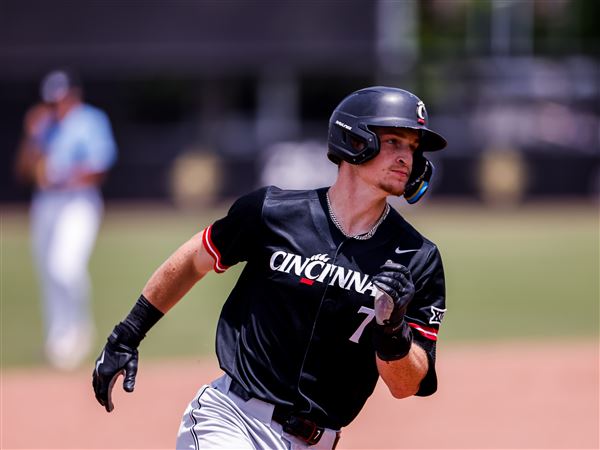
Jack Natili – C (Cincinnati)
Speaking of this year’s dense catching crop, let’s talk about Cincinnati’s Jack Natili. Natili may not be as polished an all-around prospect as Helfrick, but if we’re talking about power, it’d be silly to leave Natili out of the conversation. He has some of the best power among all college hitters in the Draft and can launch balls to all fields. Natili’s biggest weakness is probably that his long swing results in a high swing-and-miss rate on fastballs. He’ll need to shorten up that swing in pro ball if he wants to close the gap between his power and hit tools.
While not nearly as adept of a defensive catcher as Lackey and Helfrick, he is improving as a receiver and blocker behind the plate. His strong arm and leadership skills will be major assets for any team that drafts him. I predict mid-second round for Natili.
Peyton Bonds – OF (Rutgers)
If the name sounds familiar, it should. Peyton Bonds is the nephew of legendary slugger Barry Bonds. At 6’5 230 pounds, he fits the bill to carry the Bonds name. While his current offensive profile doesn’t quite yet match the frame, he has excellent bat to ball skills that could allow him to develop into a plus hitter in the professional ranks. He also excels in generating bat speed and high exit velocities, but that has yet to generate a ton of power. Maybe more will come as the 20-year-old Rutgers outfielder continues to grow as a player.
Speaking of the outfield, Bonds’ defensive ability is his best trait. He has great instincts and could be a plus centerfielder at the next level. He has the passion and the makeup of his family members before him, and if he has half the professorial approach to hitting that his uncle did, we could see Peyton Bonds roaming the outfiled of a Major League Ball Park one day.
Rocco Maniscalco – SS (Oxford HS)
Without a doubt my favorite name in this entire draft. Rocco Maniscalco will be the youngest player drafted in years, at 17 years and 2 months on draft day. He shares many similarities with 2025 #1 overall pick Eli Willits, with Maniscalco showing more power, but less speed than his counterpart. Maniscalco has a reputation of being a patient hitter but had an uneven showing in his senior season at Oxford High School in Alabama, looking too aggressive at the plate at times, and too passive at others. He is a switch hitter with more power from the left side, and scouts are confident he’ll find that consistency with age.
He is a good runner who could add quickness as he grows, and there is little question about his defensive ability at short. He projects as a plus defender with the arm strength to match, with Baseball America ranking Maniscalco as the 3rd-best defensive infielder among all the high schoolers in this draft.
Maniscalco is currently ranked by MLB.com as the #56 prospect in this draft, which would put him around the bottom of the 2nd or top of the 3rd round. Looking at all of his tools, Maniscalco profiles as an average prospect, outside of his plus arm and defense. He even measures a tick below average with his hit tool, so I think it would behoove the Mississippi St. commit to head to Starkville and continue to grow and develop those tools.
Landon Thome – 2B/3B (Nazareth Academy)
Another familiar name from days gone by, Landon Thome is the son of MLB Hall-of Famer Jim Thome. A great player in his own right, the younger Thome is ranked as the 37-best prospect in the Draft by MLB.com. Thome is viewed as one of the best all-around hitters in the 2026 high school crop. He turns his left-handed swing loose with maximum intent (just like his father) and has the bat speed and plus pitch recognition to make a lot of hard contact.
Thome has below average speed and may lose a step as he continues to fill out. It is unlikely that he’ll have the quickness or range to stick at shortstop at the next level, whether that’s in college at Florida State or in pro ball. Scouts are unsure if he’ll be quick enough to play second base or the arm strength to play third base, so Thome could end up in left. The development time will be crucial for Thome’s future, but one thing’s for sure: Landon Thome has the hitting makeup to be a pro. The rest? We’ll see.
Those are just a few of the most interesting draft prospects outside of the top 10. Maybe I’ll do something like this again after the draft, once we know where these guys are headed. Catch the 2026 MLB Draft on July 11-12th in Philadelphia.


Leave a Reply