Since we’ve been talking so much about drafts lately, let’s turn our attention to the 2026 MLB Draft. The Draft takes place from July 11-13 in Philadelphia.
Since I had SO much fun doing the Prospect Spotlight series prior to the season (I’ll be doing midseason updates VERY soon), I thought I’d lean into that and breakdown my projected top 10 picks. similar to what we did with our post, 2026 NBA Draft: Breaking Down the Projected Top 10 Picks. The biggest difference and the difficult part about doing an MLB ‘mock draft’ of sorts is that, unlike the NFL and NBA drafts where you can look at your immediate team needs and address them, the MLB Draft is all about potential. As I mentioned in our post about the proposed overhaul to the future drafts, roughly 90% of draftees never make it to the major leagues, and those who do take an average of 3-6 years in the minors before debuting. That makes it tougher to make “best fit” picks. Instead, organizations take the best prospects available and figure out fit later.
Another challenge that is unique to the MLB Draft is that organizations must decide if they’d rather take a more pro-ready college prospect, or take the raw upside of an 18-year-old phenom. That being said, here is the Empire Sports Talk Mock Draft of the first 10 picks:
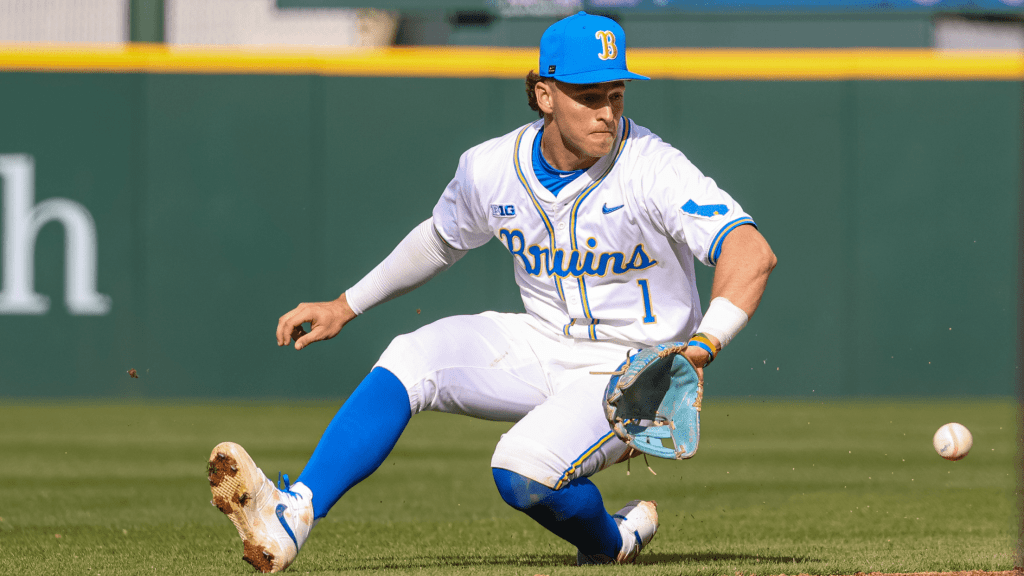
1. Chicago White Sox – Roch Cholowsky – SS (UCLA)
Much like this year’s NBA Draft, it seems pretty unanimous which three names will come off the board first. The matter of debate is which order those names will be called in.
Every mock draft I’ve seen leading up to this year’s event seems clear on the #1 pick: UCLA shortstop Roch Cholowsky. The top of this year’s draft prospect board is loaded with middle infielders, and Cholowsky tops the list.
Cholowsky could be big-league ready in a hurry, which is ideal for a young Chicago White Sox team that is WAY ahead of schedule. He is a plus defender with a plus arm with instincts to boot. He routinely finds the barrel and doesn’t swing and miss much. He combines an advanced approach at the plate with 70-grade raw power, which is a major reason why he not only finds himself at the top of most draft projections, but also as a finalist for the Gold Spikes Award. Sounds like a pretty good summer.
Cholowsky is a natural leader who also played quarterback in high school. His plus ability and athleticism, coupled with an expected express lane to the Bigs make him a clear choice at #1 for the upstart White Sox.
2. Tampa Bay Rays – Grady Emerson – SS (Fort Worth Christian HS)
Like I said, the top of this draft is loaded with middle infielders, and one such prospect is Grady Emerson out of Texas. Despite being just 18 years old, scouts struggle to find any flaw in Emerson’s game. If pressed, they may come back with “Uh,,,he’s not Bobby Witt Jr.?” Well, who is?
He focuses on hitting the ball hard – a skill which could develop into 20-25 home runs a year in the future. Baseball America grades Emerson as the best overall high school hitter, as well as having the best plate vision of any player in his class. The Gatorade National Player of the Year may also be too smooth a defender for his own good. It’s easy for his fielding ability (which may be his best tool) to go under the radar simply because of his ability to make the toughest plays look easy. His best comp MAY be Bobby Witt, though he doesn’t have Witt’s speed.
Sitting at #2 the Tampa Bay Rays, whether they admit it or not, are still looking to get out from under the looming shadow of their last top SS prospect, Wander Franco. Grady Emerson probably has a few years of minor league development ahead of him, but all signs point to the fact that he could finally be the guy to help Tampa Bay do that.
3. Minnesota Twins – Vahn Lackey – C (Georgia Tech)
There’s something that just seems right about the idea of Minnesota taking a catcher. The last time they drafted a catcher in the first round, it was a hometown guy named Mauer, and he ended up having a Hall of Fame career. Then in 2018, they took another catcher in the 2nd round in Ryan Jeffers, and some would say he was their best hitter to start 2026, before he was sidelined with an injury. Point being, Minnesota taking a catcher in the early rounds just fits.
Enter Vahn Lackey out of Georgia Tech. Some mock drafts from earlier in the spring even had Lackey going first overall to Chicago. For now, I have him at number 3. Speaking of teams that have a history of high-value catchers, Vahn Lackey is set to join Jason Varitek, Matt Wieters, Joey Bart and Kevin Parada as first-round backstops out of Georgia Tech.
Lackey is the best catcher is this draft and is extremely athletic behind the plate. He has improved each year at Georgia Tech, leaving whichever team that drafts him with high expectations as he starts his professional journey. He hits the ball hard to all fields and has the raw power to give a team 20 homers a year. He makes consistent contact and doesn’t miss the fastball. Baseball America has Lackey ranked as the 2nd best college athlete in this draft, behind only Justin LeBron from Alabama.
When Joe Mauer aged, like most catchers, he transitioned to first base. Lackey however, played several games at third base for GT in 2025 and did not commit an error. This gives Lackey a solid backup plan if he doesn’t stick at catcher, but it would seem he has all the intangibles and skills to do just that.
4. San Francisco Giants – Jackson Flora – RHP (UC Santa Barbara)
Jackson Flora is the best pitching prospect in this draft – by a pretty large margin – so it would make sense that he’d be the first pitcher off the board. Flora has a fastball that sits at 97 MPH and regularly touches triple digits. He has two different sliders that move in different ways and can present anywhere from 79 to 89 MPH. He also features a changeup that has hard downward action, similar to a splittler.
He’s a strike-thrower who, physically reminds me a lot of another former top pick, Stephen Strasburg. Like Strasburg, Flora has an electric fastball and wicked breaking stuff. He’s got three plus pitches with a fourth coming along.
The San Francisco Giants are a team that has struggled to find consistent pitching in the years since their multiple title runs in the 2010s and desperately need to find some backup for ace Logan Webb. Flora feels like he can break into the Bigs relatively quickly. And if he gets taken by the Giants, his big league home would only be about 5 hours from his college stomping grounds at UC Santa Barbara, and 6 hours from the final destination of his UCSB teammate and Los Angeles Angels top prospect Tyler Bremner.
5. Pittsburgh Pirates – Eric Booth Jr – OF (Oak Grove HS)
Eric Booth Jr. May be the fastest player in this entire draft. The son of a record-setting collegiate kick return specialist, Junior inherited his father’s speed and athleticism. His speed may be his best tool (70-grade), but it’s far from his only tool. He makes consistent contact and finds the barrel often. He has a bit of an unorthodox swing that professional pitchers could exploit, but Baseball America ranks him as one of the best high school players in this draft in terms of strike zone judgement, so if he tightens up his mechanics, he should be fine.
His exceptional speed allows him to cover a lot of ground in the outfield, but he isn’t the most efficient route runner to the ball. That coupled with his lack of a strong arm makes him an average defender, but as a prep athlete, he has time to improve in those areas. He’s currently listed as a center fielder, but I think left is the spot for him while he develops defensively.
Some drafts have Jacob Lombard listed above Booth at 5 but given that Pittsburgh JUST elevated their top prospect Konnor Griffin, it feels too soon to be thinking about the next “shortstop of the future. They need a bat, and the Oneill Cruz center field experiment has been a bad one, so drafting Booth feels like the way to go here.
6. Kansas City Royals – Jacob Lombard – SS (Gulliver Prep HS)
Speaking of Lombard, this feels like the spot for the younger brother of Yankees prospect George Lombard Jr. Some believe that Lombard has the highest ceiling of any player in the draft. Many scouts believe that Lombard has the tools to be a plus hitter in the Majors. He has plenty of raw power and has added more strength as of late. He does have a tendency to struggle with catching up to fastballs up in the zone, which could be a problem as he gets to the higher levels of pro ball, as pitchers have increasingly been using the high fastball to get hitters out in recent years.
He has plus speed, and like Eric Booth Jr. is one of the fastest players in the Draft. He has the skills to play short for a long time, though there are questions about his arm strength. If he lands with the Royals at #6, I don’t imagine Kansas City will be keen on messing with Bobby Witt Jr., so moving Lombard to second could solve that problem.
My only concern with Lombard is between the ears. There have been reports that he was too susceptible to outside voices and advice while on the Showcase circuit. If he can just quiet the noise and let his game do the talking, he’ll be fine.
Maybe it’s just me, but looking at his tape, Lombard reminds me a lot of former #1 overall pick Royce Lewis. The two are roughly the same size and plus hitters, although Lombard isn’t quite on Lewis’ level. Both have advanced speed and run freely, and despite breaking in as a SS, Lewis has played all over the field in his big-league career – something that Lombard might be forced into if he’s taken by KC, with Bobby Witt standing in his way.
7. Baltimore Orioles – Cameron Flukey – RHP (Coastal Carolina)
Baltimore has a lot of young talent at the Major League level, but most of it is one the offensive side. In my opinion, Baltimore should take a pitcher at number 7, and because of the arbitration clock has already started ticking on many of their young studs, the O’s need to try to win now. It looked like they were headed in that direction a couple of years ago, but then, they had a down year in 2025, fired former Manager of the Year Brandon Hyde, failed to re-sign Corbin Burnes and traded former 1st round pick Greyson Rodriguez to the Angels. So, the Orioles need pitching…now.
For a couple of reasons, I have Baltimore taking RHP Cameron Flukey. Some may view this as a bit of a reach as Baseball America doesn’t have him coming off the board at 23 to the Cubs and Perfect Game predicts him at 13 to St. Louis, and MLB.com slots him at 15 to Arizona. So why do I have him at 7? Flukey is arguably the best arm available behind Flora. MiLB.com has him ranked only behind LHP Gio Rojas for that honor. I could’ve chosen Rojas, who is regarded as the best southpaw in the draft, but I didn’t for two main reasons: 1) there are questions about Rojas’ command, and 2) with all the young MLB talent in Baltimore, the organization should prioritize college pitchers who can reach the Show quickly. Flukey, Liam Peterson & Hunter Dietz are prime candidates for that.
If I were the Orioles, I would choose between Flukey and Peterson. The reason I would lean toward Flukey is because few players get more swing and miss on their fastball OR curveball than Flukey. His 6’6 frame creates tough angles for opposing hitters. His fastball tops out at 98, and he has an ability to stay in that upper range, even late in games. His off-speed stuff has exceptional spin and gets a ton of swing-and-miss because of it. The Orioles need someone who can get to Camden Yards fast, and Cameron Flukey definitely has the repertoire to do that.
Unrelated, because we’re only forecasting the top 10 picks, but if the Los Angeles Angels don’t take one of these fast-track college arms at #12 (MLB.com predicts Peterson), I will RIOT… (more on that in a later post).
8. Athletics – Drew Burress – CF (Georgia Tech)
The Athletics are on the rise and have a ton of young talent at the highest level who they are systematically locking up long-term. One of those players is SS Jacob Wilson, which makes me feel like they’re not looking to select another one this high, despite this draft being loaded at that position.
Instead, I think they should focus in on a college bat, and Drew Burress is projected to potentially be the first outfielder off the board, though I have him being taken second after Eric Booth Jr, though he may be the more complete player of the two. He has solid or better tools across the board, and although he is a bid undersized, he has the raw power and defensive ability in center to make up for it.
He is a confident guy, some may say overly so, but he has a high baseball IQ and the work ethic to back up his talk. He has good plate discipline and all the intangibles to stick in center field, though he has the range and arm strength to play anywhere in the outfield.
Burress is the complete package, and many teams are high on him. I’d actually be a little surprised if he fell to the Athletics at 8, but if he does, I think he could advance through their system quickly and be a part of that bright future for a long time. Plus, before too long, the A’s will be in Vegas, and to me…Drew Burress feels like Vegas.
9. Atlanta Braves – Tyler Bell – SS (Kentucky)
I made a lot of considerations here, but the one thing they all had in common was one thing: they played shortstop. This is something that Braves have needed to find an answer for since Dansby Swanson departed for Chicago following the 2022 season. Even though I stated at the top of this page that teams rarely consider current MLB on-field needs when drafting prospects, I realize I’ve done that a lot in this top 10. But that’s possibly because there several pro ready players who could reach the higher levels quickly. Taking that into consideration, the Braves’ main need happens to be the thing this draft has in spades.
There are a couple of college level shortstops who could fill the need sooner rather than later. Justin Lebron from Alabama is an impressive mix of raw power, speed, and defensive ability. Chris Hacopian might be the best hitter of the three college options I’m going to mention here, but he may profile best as an MLB second baseman to a lack of speed and arm strength. That’s why I’m going with Tyler Bell. He may be the safest pick in this spot for Atlanta based on need and timing. As a switch hitter, he is proficient from both sides of the plate and has the bat speed and raw power to produce 20 homers a year.
He’s a solid defensive shortstop with the highest rated strike zone judgement of any college hitter in this year’s draft. Some may have Lebron or Hacopian rated higher than Bell in this spot, but I feel confident in the pick. If the Braves are willing to take a few more years with stop-gap solutions to allow a high school prospect to develop, then Tyler Spangler or Cole Prosek would definitely be the way to go (I think I’d lean toward Prosek), but that’s up to the front office. But given that the Braves are about to have to make some significant contract decisions with some of their stars, they feel like they’re in win-now mode. That said, I’d go with Tyler Bell and hope he can be fast-tracked.
10. Colorado Rockies – Gio Rojas – RHP (Stoneman Douglas HS)
This one feels obvious: the Rockies have always struggled to acquire pitching or hang on to it long-term, so they need to develop it from the Draft. Because of that, I always recommend the Rockies look for hurlers who feature a pitch with weight, such as a sinker or a cutter. Arkansas’s Hunter Dietz fits that mold with an upper-80s cutter, but I have concerns when it comes to injury. Dietz has had multiple surgeries to repair a stress fracture in his elbow he suffered in 2023. Anytime the words “elbow” and “surgery” come up with pitchers, there’s immediate cause for concern.
Additionally, I think the Rockies are following the build-from-within, chemistry model set forth by the White Sox, Athletics and Marlins, though they are a few steps further behind. Therefore, unlike some teams on this list, they can afford to take their time and develop a higher upside high school prospect. That’s why I’d go with LHP Gio Rojas at 10, if he’s still available. Widely viewed as the best southpaw in the draft, high school or college. He can run his fastball up to 98 MPH and can command it really well. He has an outstanding sweeping slider that can be a true out pitch at the next level. He has a change that he doesn’t use much, but with time, there’s no reason he can’t develop it into a third quality pitch.
If I was the Colorado pitching coach, while we’re developing his changeup, I’d make a slight adjustment. I’d alter the grip and make it a circle change. As I mentioned, with the thin air of Colorado, “weight” is crucial. Yes, the easier answer as stated above, would be to teach him a sinker or a cutter. That’s why I liked Dietz – his cutter, but a circle change can be just as effective. It may not have as much ‘perceived weight’ as the others, but a circle changeup feels heavier to the batter. The grip creates more downward movement and arm-side sink than a regular change. Couple with that with a 3/4 arm slot from Rojas, and the adjustment could cause problem for opposing hitters.
Those are my projections for the top 10 picks of the 2026 MLB Draft. Stay tuned for a future post where I break down some prospects who didn’t quite crack this list but are making noise in the process. God, I love this…


Leave a Reply