
If you’ve been following the early stages of baseball’s upcoming CBA negotiations, you’ve probably noticed that the conversation has quickly moved beyond salary caps, luxury taxes, and deferred contracts.
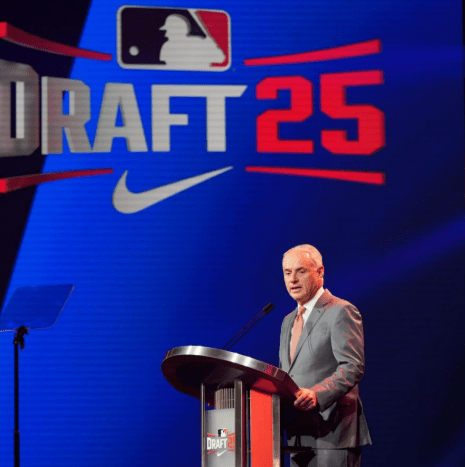
This week, Baseball America’s J.J. Cooper reported on one of the most sweeping proposals Major League Baseball has put on the table in years: eliminating high school players from draft eligibility entirely, reducing the draft from 20 rounds to 12, and restructuring the international amateur market through a separate international draft.
In other words, MLB isn’t just talking about changing the draft. They’re talking about fundamentally changing how baseball develops talent. And personally, I think eliminating high school draftees would be a huge mistake.
According to the proposal, players from the United States and Canada would not become draft eligible until after their sophomore year of college, effectively forcing virtually every elite amateur player into the college baseball system before beginning a professional career. MLB argues that modern college baseball has evolved into a stronger developmental pathway than ever before thanks to NIL opportunities, expanded scholarships, revenue sharing, improved facilities, and enhanced player development resources. The league believes this would strengthen college baseball while helping fans become more familiar with future stars before they reach professional baseball.
I understand the argument. I just don’t agree with it.
The biggest issue for me is simple: why would Major League organizations voluntarily give up years of developmental control over their most talented players?
Historically, roughly 40% of first-round picks come directly out of high school. Teams have always weighed risk versus upside when evaluating amateur talent. College players are often viewed as safer selections because there’s more information available. High school players are often viewed as lottery tickets with enormous ceilings. Sometimes they flame out. Sometimes they become Hall of Famers. That’s baseball.
But if you’re a front office, wouldn’t you want the opportunity to mold that talent yourself? After all, we know how long development takes.
Roughly 90% of drafted players never reach the Major Leagues. Those who do generally spend anywhere from three to six years in the minor leagues before making their debut. So ask yourself a simple question:
If your organization’s top prospect is going to spend four years developing anyway, would you rather he arrive in the big leagues at 22 years old or 26?
That answer feels pretty obvious.
One anonymous scout quoted in Baseball America’s reporting asked an even better question.
“Some of the greatest players who ever played, played the game at 19. Why would we want to eliminate that?”
It’s hard to argue with that logic.
Ken Griffey Jr. debuted at 19. Alex Rodriguez debuted at 18. Bryce Harper arrived at 19. Mike Trout debuted at 19. Clayton Kershaw debuted at 20. The history of baseball is filled with stars who reached the majors before they could legally order a drink. Why would the sport intentionally close that pathway?
Another scout pointed out something that often gets lost in these discussions.
“We are robbing players of the choice. Some people are not academic.”
That’s an important point. College works for many people. It doesn’t work for everyone.
Some young players are ready to begin their professional careers immediately. Some come from families where a seven-figure signing bonus can be life-changing. Another anonymous scout made that exact point, noting that a large signing bonus can literally save a family financially.
It’s easy to talk about development paths and educational opportunities from a conference room. It’s a lot different when you’re asking a teenager to walk away from generational money because you’ve decided college is better for him.
Now, not everyone opposes the idea.
Vanderbilt head coach Tim Corbin was among those who expressed support, arguing that college baseball would become significantly more visible nationally if elite players were required to spend time on campus before entering professional baseball. That’s a fair point. College baseball has never been healthier. Attendance is growing. Television exposure is improving. NIL has changed the landscape dramatically. There’s no denying that forcing more elite talent into college baseball would elevate the product.
But here’s where I think the proposal runs into trouble. I don’t think the teams themselves are going to love it.
Owners may have proposed the concept, but general managers, scouting departments, and player development staffs have spent decades building systems designed to identify and cultivate talent as early as possible. The sooner a player enters your organization, the sooner you can shape his swing, his delivery, his approach, his nutrition, his strength training, and his mental preparation. Development isn’t just about improving players. It’s about doing it your way.
Removing high school players from the draft doesn’t increase organizational control. It reduces it.
That’s why, despite all the attention this proposal is receiving, I remain skeptical that it ultimately survives negotiations in its current form.
The proposal also includes shortening the draft from 20 rounds to 12 and significantly reducing amateur spending, moves that many evaluators view as cost-cutting measures more than developmental improvements.
Taken together, the entire package feels less like a modernization effort and more like an attempt to fundamentally reshape baseball’s developmental pipeline.
Maybe that’s the goal.
But baseball has always been unique because of its developmental model. Unlike football or basketball, prospects don’t simply spend a year or two in college before arriving on the biggest stage. Baseball is a sport built on development. The minor leagues matter. Amateur scouting matters. Long-term projection matters.
Taking elite high school talent out of that pipeline feels like solving a problem that doesn’t really exist.
Whether this proposal gains traction remains to be seen. The MLBPA has already pushed back aggressively against many of the proposed changes, and there is still a long road ahead before a new collective bargaining agreement is finalized.
What is clear, however, is that baseball finds itself at a crossroads.
Between discussions surrounding a potential salary cap and floor, concerns about deferred contracts, international drafts, and now the possibility of eliminating high school draftees altogether, the next CBA may end up being one of the most consequential labor agreements in the history of the sport.
Personally, I think eliminating high school players would be a massive mistake. The opportunity to have complete control over a player’s growth and development before bad habits form should be reason enough for owners, front offices, and player development departments to oppose the idea.
But whether you agree with me or not, one thing is undeniable:
Baseball is about to have some very important conversations about what its future should look like.


Leave a Reply