
I debated whether I wanted to write about this at all.
One of the guiding principles I’ve tried to follow while building Empire Sports Talk is keeping sports centered on what happens between the lines. There is already enough division in the world without dragging every political, cultural, or social debate onto the playing field. Most of the time, I’d rather talk about batting averages, playoff races, prospect rankings, and championship dreams.
But as a Christian man, I felt like I couldn’t watch the reaction surrounding the San Francisco Giants’ Pride Night and simply let it pass without comment.
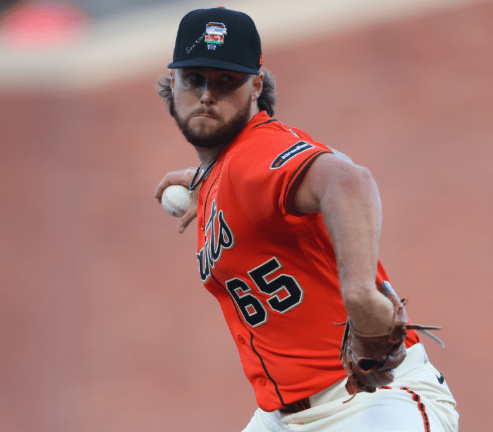
Before going any further, I want to commend Giants pitchers JT Brubaker, Landen Roupp, and Ryan Walker for standing by their faith. Whether you agree with them or not, it takes conviction to publicly hold to your beliefs when you know criticism is coming. In a culture that constantly celebrates people for “living their truth,” it seems strange that some people suddenly become uncomfortable when Christians do the same.
What disturbed me most about this story wasn’t the actions of the players. It was the reaction.
The Athletic published a headline stating that several Giants players wrote Bible verses on their caps “to respond to Pride Night,” adding that the gesture echoed a familiar pattern of making “a night meant for inclusion about something else entirely.”
I originally intended to spend much of this article discussing the specific verses the players chose to write—Genesis 9:12-16—and the biblical significance of God’s covenant symbolized by the rainbow. But the more I thought about it, the more I realized the real issue isn’t the verses themselves. It’s the assumption behind the criticism.
The Athletic argued that the players made the night about something else. I would argue the exact opposite.
The players wore the league-approved hats. They participated. They took the field. The only addition was a small biblical reference that reflected their personal faith. They did not hold a press conference. They did not protest. They did not attempt to disrupt the event. They simply expressed a belief that has been central to Christianity for thousands of years.
The media chose to turn that into a controversy. More importantly, none of this is new.
Clayton Kershaw has written Bible verses on Pride Night caps for years. Tim Tebow famously wrote Bible verses on his eye black throughout his college career at Florida. In fact, Tebow’s references became so popular that the verses themselves routinely became some of the most searched terms on Google the following day. Public expressions of faith in sports are not some recent invention. Athletes have been doing it for decades.
What’s changed isn’t the athletes. It isn’t the beliefs or the principles on which those beliefs are founded. What’s changed is the reaction. The hypocrisy becomes even more obvious when you reverse the scenario.
Imagine a team hosting a Faith & Family Night. Imagine a player who supported LGBTQ causes—or practiced a different faith altogether—quietly choosing not to participate in certain festivities. Do you honestly believe the media would attack that player?
Of course not.
Most likely, that player would be praised for standing by their convictions and remaining true to themselves. That’s where this conversation stops being about inclusion and starts becoming about ideological consistency.
One Giants player, Sam Hentges, chose not to wear the special cap at all and instead wore his regular team hat. Honestly, if I were in that position, that’s probably the route I would have taken. It was a quiet, respectful way to remain true to his beliefs without drawing attention to himself.
Yet even the players who chose a different path and added Bible verses were met with criticism and, eventually, formal warnings from Major League Baseball.
According to reports, MLB informed the players that their actions violated uniform policy and that future violations could result in fines. That would carry more weight if Major League Baseball had a history of actually enforcing such policies.
The problem is that they don’t.
There appears to be little precedent over the past decade for MLB aggressively fining players over minor uniform modifications. Even more notably, Kershaw’s similar use of those Bible verses on HIS Pride caps has existed for years without meaningful intervention from the league.
Kershaw’s faith has never exactly been a secret. Since 2011, he and his wife Ellen have hosted Ping Pong 4 Purpose, a charity fundraiser supporting their Christian ministry, Kershaw’s Challenge. The event is held annually at Dodger Stadium. His public witness has been welcomed and celebrated throughout much of his career.
That’s why these warnings feel less like consistent enforcement and more like selective enforcement.
And that’s where Major League Baseball deserves criticism.
What’s particularly interesting is that Pride Night itself is not even mandated by MLB.
The Texas Rangers remain the only Major League organization not hosting a Pride Night in 2026. Instead, the Rangers continue to host a Faith & Family Night. That decision was made by the organization. Major League Baseball did not punish them. The league did not force them to change course. The Rangers exercised their right to determine what events best reflect their organization. As they should.
If organizations have the freedom to choose whether they host these events, and they do, then individual players should have similar freedom in how they respond to them, as long as those responses remain respectful.
Some media outlets labeled the Rangers’ decision malicious. But that criticism reveals a larger problem in modern sports discourse. We constantly hear calls for tolerance, inclusion, and acceptance. But too often, those values seem to apply only when someone reaches the “correct” conclusions. It’s religious discrimination in the name of “tolerance”.
True tolerance isn’t tested when everyone agrees. It’s tested when people don’t. If inclusion only extends to people who share your worldview, then it isn’t inclusion at all.
That’s why this story resonates beyond baseball. It isn’t really about a baseball cap. It isn’t even about Pride Night. It’s about whether athletes-or anyone, really-are allowed to express sincerely held religious, political or social beliefs without being treated as though they are attacking someone else simply by existing. Take Jaxson Dart for instance in the NFL. He received rampant criticism (even from his own teammate) simply for accepting an invitation to introduce President Donald Trump at a rally. I have long held the personal belief that the office of the President should be respected, regardless of who is occupying it or whether or not I voted for him. If I had an opportunity to accept an invitation from a sitting President – any president – I would be honored to accept.
For years, sports have celebrated authenticity. We’ve told athletes to use their platforms. We’ve praised them for standing for causes they believe in. We’ve encouraged them to be themselves.
That principle should apply to Christians, too.
You don’t have to agree with JT Brubaker, Landen Roupp, Ryan Walker, or Sam Hentges, though they have found much more support for their actions than the media would have you believe. That’s not the point.
The point is that tolerance works both ways.
And if we’re serious about inclusion, then there has to be room in sports for people of faith as well.


Leave a Reply