
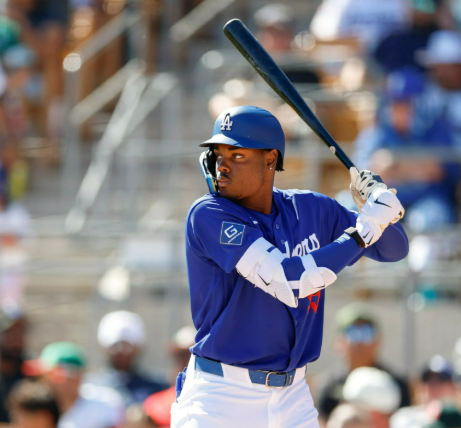
When I put together my Prospect Spotlight series earlier this year, I chose to focus on Dodgers shortstop Emil Morales. At the time, Morales intrigued me because of his power upside and the fact that he represented something we don’t often discuss when talking about Los Angeles: the future.
The Dodgers are almost always focused on the present.
That’s what makes the emergence of outfielder Josue De Paula so fascinating.
While Morales was the prospect I highlighted, it has been De Paula—and fellow Dodgers outfielder Mike Sirota—who have been lighting up the stat sheet in 2026. In fact, Baseball America’s Geoff Pontes recently named De Paula one of the hitting prospects who stood out most during the month of May. That’s hardly surprising when you consider the season he’s putting together. He hit .340 in May with 20 extra base hits, and pitchers have had a hard time getting the ball past him, with a 14% in-zone miss rate and an 18% chase rate.
At just 21 years old, De Paula has developed into one of the premier prospects in all of baseball. MLB Pipeline ranks him as the Dodgers’ top prospect and the No. 8 prospect overall. Scouts rave about his advanced approach, power potential, and ability to impact the game offensively in multiple ways. He has walked more than he has struck out so far in 2026. Every month that passes seems to bring another reminder that this kid can flat-out hit.
But as I was reading through some of the recent prospect coverage, Baseball America posted something on X that immediately caught my attention:
“Breaking into the Dodgers’ everyday lineup is one of the toughest things to do in sports. But De Paula might be the rare LA prospect good enough to do it.”
That’s a fascinating statement.
Because I agree with the first half completely.
Breaking into the Dodgers’ lineup might genuinely be one of the hardest jobs in professional sports.
The second half, however, raises an interesting question:
What if he can’t?
Now before Dodgers fans start sharpening their pitchforks, let me be clear. This isn’t an article arguing that De Paula isn’t talented enough. Quite the opposite. I think he’s absolutely good enough to become an impact Major League player. The question isn’t whether he can play.
The question is whether Los Angeles will ever have room for him. History tells us that prospects and opportunity don’t always arrive at the same time.
The Dodgers are built to win championships right now. They’re aggressive. They’re creative. They spend money. They trade prospects. They sign stars. When an opportunity arises to improve the Major League roster, they rarely hesitate.
That’s one of the reasons they’ve become the gold standard organization in baseball. But it’s also why some prospects ultimately find their biggest opportunities elsewhere. We’ve seen this story before.
Fernando Tatis Jr. was once a White Sox prospect. In June of 2016, Chicago sat at 27-26 and believed it could make a playoff push. Looking for pitching help, they traded a 17-year-old Tatis to San Diego for veteran starter James Shields. At the time, Tatis hadn’t even made his professional debut. Today, he’s one of the faces of baseball.
David Ortiz spent parts of six seasons with the Minnesota Twins before being released. The Twins saw a solid player. The Red Sox saw a franchise icon. Ortiz became the centerpiece of multiple championship teams, helped break the Curse of the Bambino, and eventually earned a plaque in Cooperstown.
Max Scherzer’s story wasn’t much different. Arizona drafted him, developed him, and gave him his first opportunity in the big leagues. Then they traded him to Detroit before he fully blossomed into the future Hall of Famer we know today. Scherzer didn’t even win his first Cy Young Award until after he had already left the organization that drafted him.
Jose Bautista bounced around baseball for years before finally becoming “Joey Bats” in Toronto. By the time he became a superstar, he was already on his fifth organization. Shea Langeliers was one of Atlanta’s best prospects before being moved to Oakland in the Matt Olson deal. Both organizations would make that trade again today, but Langeliers has since developed into one of the American League’s premier power-hitting catchers.
And those are just a handful of examples.
Baseball history is filled with players who found their breakthrough somewhere other than the organization that originally signed or drafted them.
That’s why De Paula’s situation is so intriguing.
The Dodgers are loaded at the Major League level. They have stars everywhere. They have one of the highest payrolls in sports. They aren’t afraid to make blockbuster additions whenever they identify a need. That’s a wonderful problem for a contender to have, but it can create a traffic jam for prospects trying to force their way onto the roster.
Looking ahead, there are reasons for optimism if you’re hoping De Paula eventually becomes a fixture in Dodger Stadium. Teoscar Hernández isn’t under contract beyond 2027. Andy Pages remains relatively inexpensive and under team control through 2031, but baseball rosters evolve quickly. Injuries happen. Trades happen. Contracts expire.
Openings eventually appear.
At the same time, we’ve watched the Dodgers operate long enough to know that they rarely allow future uncertainty to prevent them from making present-day moves. If another superstar becomes available, Los Angeles won’t hesitate simply because it might impact a prospect’s timeline. That’s what contenders do.
Which brings us back to De Paula.
Maybe he’s the rare prospect who is simply too talented to ignore. Maybe Baseball America is right, and he eventually forces his way into one of the deepest lineups in baseball. Maybe he becomes the next homegrown Dodgers star and spends the next decade launching baseballs into the pavilion seats. Or maybe he becomes the centerpiece of a blockbuster trade and ends up becoming a star somewhere else.
Neither outcome would be surprising.
The Dodgers have built a machine designed to win championships. Sometimes that means developing stars. Sometimes it means acquiring them. Sometimes it means using one to acquire the other.
What seems increasingly clear, however, is that Josue De Paula is going to be a Major League player. A very good one, potentially. Whether that future unfolds in Los Angeles or somewhere else remains one of the more fascinating prospect stories in baseball.
For now, all we can do is watch. And based on what De Paula is doing in 2026, he’s making himself impossible to ignore.
 Empire Sports Talk
Leave a comment