
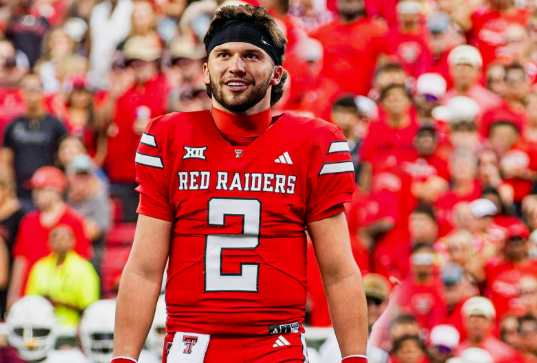
There are very few stories in sports that immediately make your mind wander to Pete Rose. The Brendan Sorsby situation is one of them.
Now, before anyone starts firing off angry comments, let me be clear: These two situations are very different, and I have very different feelings about them, but this Texas Tech situation is beginning to feel just as heavy on the sport of college football, the way that Rose’s situation weighed on baseball. Whenever gambling becomes attached to an athlete’s eligibility, particularly when that athlete is accused of wagering on games involving his own team, it’s impossible not to think about Rose and the shadow his case continues to cast over sports decades later.
That’s what makes this story feel so important.
At its core, this should have been one of the easiest eligibility decisions the NCAA has ever made. According to reports, Sorsby admitted to placing approximately $90,000 worth of sports wagers over a four-year period, including bets involving Indiana football while he was a member of the program. Whether those wagers impacted games or not is almost beside the point. Sports organizations draw hard lines around gambling because they have to. The integrity of competition depends on it. Fans need to believe that the players on the field are trying to win, not merely participating in games that may have financial implications beyond the scoreboard.
When the NCAA declared Sorsby permanently ineligible, I honestly thought that would be the end of the story. You can debate transfer restrictions. You can debate NIL regulations. You can debate whether the NCAA should even exist in its current form. But betting on sports, especially games involving your own team, feels like one of the few remaining issues where there should be very little gray area.
Instead, the story somehow became even bigger.
Sorsby challenged the ruling in court and eventually secured an injunction allowing him to play while the case proceeds. Adding another layer of controversy, reports emerged that the judge hearing the case was a Texas Tech graduate. Now, whether that fact had any impact on the decision is impossible to know and probably unfair to assume. Judges are expected to rule based on the law, not their alma mater. Still, the optics are terrible, and sports fans have never been particularly known for giving the benefit of the doubt when it comes to optics.
What makes this entire situation fascinating is that it has become about much more than Brendan Sorsby. In many ways, it’s become a referendum on the state of college sports itself. Every year it feels like another NCAA ruling gets challenged, another eligibility decision gets overturned, another policy gets struck down in court. At some point, you begin to wonder whether the NCAA actually governs college athletics anymore or whether it simply offers suggestions until someone finds a judge willing to hear an appeal.
Oddly enough, this reminds me a little bit of the Cam Newton situation at Auburn years ago. To be clear, Newton’s case was nowhere near as serious. Gambling wasn’t involved, and nobody was questioning the integrity of the games themselves. The controversy centered around allegations of improper benefits at a time when NIL didn’t exist. But what I remember most was how people reacted when Newton was briefly ruled ineligible, only to have that ruling reversed almost immediately. Fans around the country felt like the system had bent under pressure. Whether that perception was fair or not, it created a great deal of frustration.
If people were upset about eligibility questions involving recruiting benefits, it should surprise absolutely nobody that they’re furious about a case involving sports betting.
That’s why I completely understand the reaction we’re seeing from coaches, athletic directors, and conference commissioners. Reports suggest some schools and conferences are discussing avoiding future games against Texas Tech altogether. The Big Ten has reportedly advised member schools against scheduling the Red Raiders, and there are whispers that others could follow. On one hand, I get it. If I were a coach or an AD watching this unfold, I’d probably be frustrated too. From their perspective, the NCAA identified a serious violation, handed down a punishment, and then watched a court effectively erase it.
But the more I think about it, the more I believe they’re directing that frustration at the wrong target.
By blackballing Texas Tech, you’re not punishing Brendan Sorsby. You’re punishing a university. You’re punishing a coaching staff. You’re punishing players who had absolutely nothing to do with this situation. You’re punishing fans who simply want to watch their team play football. You’re punishing hundreds of people because of the actions of one person.
I recently heard a phrase that keeps coming back to me while thinking about this story: “Don’t bleed all over someone who didn’t cut you.”
That’s exactly what’s happening here.
Brendan Sorsby cut the NCAA. Texas Tech didn’t. head coach Joey McGuire didn’t. The student section didn’t. The offensive linemen blocking for him didn’t. Yet if schools start refusing to schedule Texas Tech, all of those people become collateral damage in a dispute they had no role in creating.
That’s why I believe the answer isn’t for conferences to isolate Texas Tech. The answer is for the NCAA to stand its ground and continue fighting to uphold its original ruling. For years, the NCAA has lost authority piece by piece as courts have chipped away at its power. In many cases, that was probably necessary. Some of the NCAA’s old rules were outdated and deserved to be challenged. But gambling on sports involving your own team feels different.
If that isn’t a line worth defending, then what line is?
Because once you start making exceptions here, you’re no longer talking about transfer rules or NIL opportunities. You’re talking about the integrity of competition itself. That’s the foundation upon which every sport is built. Without it, none of the rest matters.
The NCAA shouldn’t punish Texas Tech. The NCAA shouldn’t punish Sorsby’s teammates. The NCAA shouldn’t punish the fans. It should focus on the individual who violated the rule and continue pursuing the penalty it originally imposed.
This is one of those rare situations where the NCAA’s first instinct was actually the correct one.
There is another old saying that one bad apple can spoil the bunch. Right now, Brendan Sorsby is the bad apple. The solution isn’t to throw out the entire basket and punish everyone around him. The solution is to remove the apple before people start assuming the entire bunch is rotten.
Because if betting on games involving your own team no longer carries meaningful consequences, then college football has a much bigger problem than one quarterback’s eligibility. Like it or not, the most famous landmark case in sports revolving around gambling resulted in a lifetime ban for one of baseball’s best hitters. A lifetime ban – not a few weeks…
When did we start singing a different song?
 Empire Sports Talk
Leave a comment