
For years, Los Angeles Angels fans have been asking for change. On Tuesday, they finally got it.
Arte Moreno has agreed to sell a controlling interest in the Angels to Stan Kroenke and Kroenke Sports & Entertainment in a deal that reportedly values the franchise at $4 billion, the highest valuation ever for the sale of a Major League Baseball team. The transaction still requires MLB approval and isn’t expected to formally close until early 2027, but for a fan base that has spent years chanting for Moreno to sell the team, the message is clear: a new era is coming.
And quite frankly, it couldn’t come soon enough.
There was a time when Moreno’s tenure looked considerably different. He purchased the Angels from Disney for roughly $184 million in 2003, shortly after the franchise’s 2002 World Series championship, and the Angels won six division titles during the earlier portion of his ownership. But that success eventually gave way to one of the most frustrating stretches any fan base in baseball has endured. The Angels haven’t made the postseason since 2014, are headed toward a 12th consecutive year without October baseball and have somehow managed to accomplish that while employing some of the greatest players of their generation.
That takes a special kind of organizational dysfunction.
Now, one of the most successful owners in professional sports gets the opportunity to fix it.
How Do You Have Mike Trout and Shohei Ohtani and Win Nothing?
That’s the question that will define the latter half of the Moreno era. The Angels had Mike Trout. Then they added Shohei Ohtani.
For several seasons, they had arguably the best baseball player on the planet and another guy who was doing things baseball hadn’t seen since Babe Ruth. And they didn’t make the playoffs with the pair. Not once.
Trout has spent virtually his entire career as the face of the Angels, won three MVP awards and built a résumé that will eventually take him to Cooperstown. Yet his postseason résumé consists of three games in 2014. The Angels were swept by Kansas City, and Trout hasn’t played a playoff game since. That’s almost incomprehensible.
There was even a stretch when the Angels employed Trout, Ohtani and Albert Pujols at the same time. On a marquee, that sounds like something you’d create in a video game. In reality, the Angels couldn’t turn all that star power into a winning baseball team.
That is the Moreno era in a nutshell.
It was never necessarily about a complete unwillingness to spend money. Moreno spent plenty of it. The problem was how the Angels spent it and the complete inability to build a sustainable organization around those expensive stars.
Pujols received a 10-year, $240 million contract entering his age-32 season. Josh Hamilton got five years and $125 million. Anthony Rendon’s seven-year, $245 million contract became one of the most disastrous deals in baseball history. Even when the Angels landed stars, the roster around them was too often incomplete, the pitching wasn’t good enough and the farm system wasn’t producing enough talent to fill the gaps.
The result is one of baseball’s great “what ifs.” What would Mike Trout’s career look like if he had spent his prime playing meaningful baseball in October? We’ll never know.
The Angels Finally Started Acting Differently
Interestingly, this changing of the guard didn’t completely begin with Tuesday’s announcement. It started in June.
The Angels fired general manager Perry Minasian on June 26 after more than five seasons without a winning record and brought in longtime Cardinals executive John Mozeliak as interim GM. Mozeliak’s contract only runs through December, and there’s no guarantee he’ll remain part of the organization once Kroenke formally takes control. But his arrival immediately represented something Angels fans hadn’t seen enough of.
A willingness to make difficult decisions. That became abundantly clear at the Trade Deadline.
Before the front-office change, reports indicated Moreno didn’t want the Angels trading controllable pieces such as Jo Adell or José Soriano. That’s exactly the kind of thinking that had plagued this organization. The Angels weren’t good enough to contend, but they repeatedly resisted the kind of teardown that could help them build something better. They were seemingly trapped in baseball purgatory, too bad to win and too stubborn to rebuild.
Mozeliak changed that. The Angels traded Soriano to Toronto for a package headlined by highly regarded shortstop prospect Arjun Nimmala. They sent Adell to Cleveland for catching prospect Jacob Cozart. Brent Suter, Ryan Zeferjahn and Kirby Yates were moved as well, with Los Angeles acquiring eight prospects in its Deadline deals.
You can debate individual returns. You can debate whether the Angels should have gone even further. What you couldn’t debate was the philosophical shift. For once, the Angels looked at where they actually were instead of where they hoped they might be.
That matters.
Whether Mozeliak remains with the organization beyond 2026 will now be one of the first fascinating questions of the Kroenke era. But whoever ultimately runs baseball operations will inherit an organization that has at least started acknowledging reality.
And now they’ll have an owner with a rather impressive history of winning championships.
Stan Kroenke Knows What Winning Looks Like
If I’m an Angels fan, this is the part that has me excited.
Kroenke isn’t buying his first professional sports franchise. He’s adding another team to an empire that already includes the Los Angeles Rams, Denver Nuggets, Colorado Avalanche, Colorado Rapids and Arsenal, among others. And lately, Kroenke’s trophy room has needed some serious renovations.
The Rams won Super Bowl LVI in February 2022.
The Avalanche won the Stanley Cup four months later.
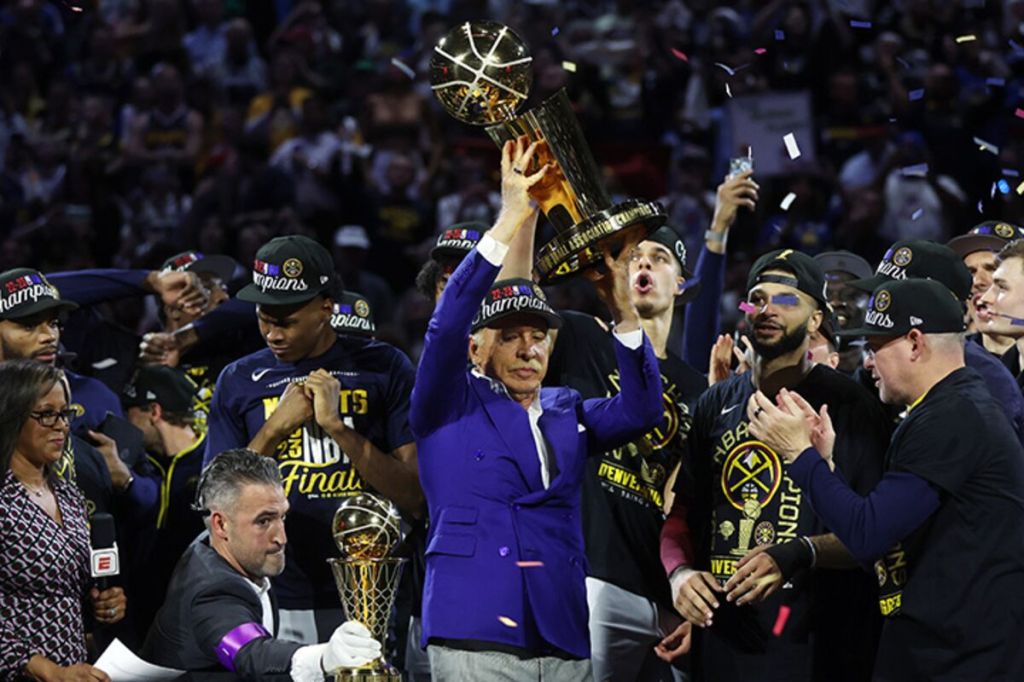
The Nuggets won their first NBA championship in 2023.
And in 2026, Arsenal won its first Premier League championship in 22 years. Kroenke’s organizations have now captured championships in five different sports over a five-year span.
That’s not a bad résumé to hand Angels fans on Day 1.
More importantly, Kroenke’s teams aren’t simply known for throwing money around. They’ve built sustainable organizations capable of contending year after year. Denver has made eight consecutive NBA postseasons. Colorado has made nine straight NHL postseasons. Arsenal has become one of the dominant clubs in English football again.
Then there’s what Kroenke has done with the Rams. If you want an example of just how aggressive one of his organizations can become when it sees an opportunity to win, look at Los Angeles right now.
The Rams were one victory away from returning to the Super Bowl last season, and apparently decided that wasn’t good enough. They made arguably the biggest splash of the NFL offseason by acquiring Myles Garrett from Cleveland in June.
Then, just days ago, Aaron Donald officially came out of retirement.
Yes, that Aaron Donald. The future Hall of Famer is back, meaning opposing quarterbacks will now have the pleasure of dealing with Myles Garrett and Aaron Donald on the same defensive front. That’s nightmare fuel.
That’s the kind of aggressiveness Angels fans should want to see.
Not recklessness. Not another $200 million contract handed to the biggest name available simply because you can.
Aggressiveness with a plan.
There’s a massive difference.
This Can’t Just Be About Spending Money
That’s also where Kroenke’s biggest challenge lies. The Angels don’t need someone to simply open the checkbook. They’ve tried that.
Moreno wasn’t a cheap owner in the traditional sense. He authorized enormous contracts. Trout remains under the 12-year, $426.5 million extension he signed during Moreno’s tenure. Rendon is making $38.6 million in the final year of his $245 million deal.
Money wasn’t enough. The Angels need infrastructure. They need player development. They need scouting. They need pitching development. They need an organization capable of identifying talent, developing that talent and supplementing it intelligently through trades and free agency. Most importantly, they need an actual direction.
That’s why I find the combination of what Mozeliak started and what Kroenke potentially represents so encouraging. Mozeliak finally acknowledged that this roster needed to be reworked rather than patched together. Kroenke now brings the resources and organizational track record to potentially take that process much further.
And there could be another enormous issue awaiting him: Angel Stadium. The 60-year-old ballpark’s future has been intertwined with Moreno and the city of Anaheim for years, including a failed stadium-land deal. Kroenke, meanwhile, knows a thing or two about ambitious stadium projects considering what KSE built with SoFi Stadium and the surrounding Hollywood Park development.
This isn’t going to be a quick fix. It shouldn’t be. Baseball rebuilds take time, particularly when you’re trying to repair an organization rather than simply improve a 26-man roster. But for the first time in a long time, there’s reason to believe the Angels might actually have the patience, resources and direction necessary to do it correctly.
And Then There’s Mike Trout
This is the part that makes the timing bittersweet. Trout is 34 years old. The Angels can’t give him his prime back. They can’t undo all those summers when one of the greatest players baseball has ever seen was sitting at home in October. They can’t go back and build a rotation around the younger version of Trout. They can’t reconstruct the Ohtani years or turn that absurd collection of individual talent into the contender it should have been.
But maybe they can still give Trout something. A chance. That’s all I want to see.
Trout remains under contract through 2030, and there’s plenty of uncertainty about what kind of player he’ll be by the time the Angels are truly ready to contend again. Maybe Kroenke and the eventual baseball operations department decide a trade makes sense. Maybe Trout wants to finish his career in Anaheim. Maybe the Angels can accelerate this turnaround enough to give him one more legitimate run in October wearing the only Major League uniform he’s ever known.
Whatever happens, I’d love to see Mike Trout playing meaningful baseball again. And Kroenke’s arrival makes that possibility feel just a little less ridiculous.
Angels Fans Can Finally Look Forward
There are no guarantees here.
Owning successful franchises in football, basketball, hockey and soccer doesn’t automatically mean Kroenke will build a World Series champion. Baseball is different. Player development takes years. Prospects fail. Free agents disappoint. Even well-run organizations can go through extended stretches without winning championships.
But Angels fans don’t need guarantees right now. They need competence. They need direction. They need an organization willing to make uncomfortable decisions when those decisions benefit the franchise five years from now rather than five days from now.
They need an owner whose expectation isn’t merely to put recognizable names on billboards, but to build something capable of winning. That’s what makes this sale feel so significant.
Arte Moreno bought the Angels immediately after their greatest moment. Twenty-three years later, he’s leaving behind a franchise headed toward its 12th consecutive season without a playoff appearance despite having employed Mike Trout and Shohei Ohtani during the same era.
That’s a staggering failure.
Now Stan Kroenke gets the opportunity to write the next chapter. Maybe John Mozeliak is part of it. Maybe he isn’t. Maybe the rebuild takes three years. Maybe it takes five. Maybe Mike Trout gets one last October run in Anaheim, or maybe the next great Angels team is ultimately built around players who aren’t even in the organization yet.
Nobody knows. But after years of watching the Angels wander through baseball without a coherent direction, their fans finally have something they haven’t had enough of.
Hope. Purpose. Direction.
For a franchise that has spent more than a decade wasting some of baseball’s greatest talent, that’s a pretty good place to start.
 Empire Sports Talk
Leave a comment