
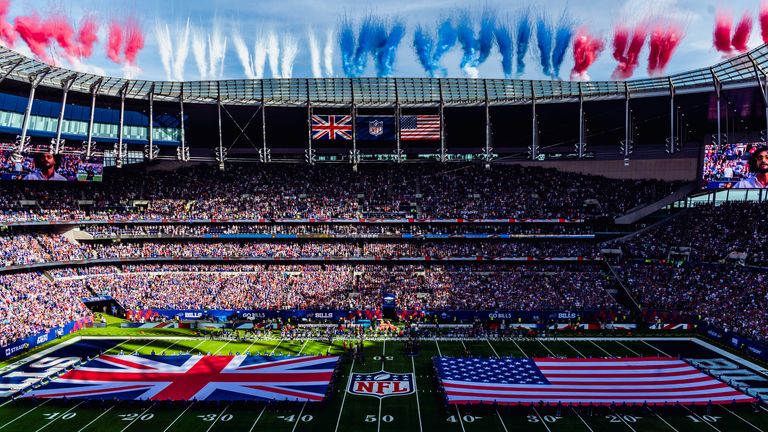
Roger Goodell has made no secret about his desire to turn the NFL into a truly global sports league, going so far as to double down recently and say he has “no doubt” that the NFL will eventually expand outside the US.
International games have steadily expanded. London has become an annual destination. Germany, Mexico and Brazil have joined the rotation, and the 2026 season will feature a record nine international games across four continents. The league will play in England, Germany, Spain, France, Mexico, Brazil and Australia this season.
Apparently, that’s still only the beginning.
Goodell recently went a significant step further, saying he has “no doubt” the NFL will eventually have teams based outside of the United States. He also reiterated his belief that an international city could eventually host a Super Bowl.
I’ve barked up this tree for years, so I’ll say the same thing now that I’ve said every time the subject comes up:
I think this is a terrible idea.
I enjoy the occasional international game. The atmosphere can be incredible, international fans deserve opportunities to see NFL football in person, and growing the sport globally is objectively good for the league.
But there’s an enormous difference between taking the NFL to international fans a handful of weekends every season and permanently putting franchises on another continent.
One is a spectacle. The other is a logistical nightmare.
London Is Fun to Visit. Living There Is a Different Story.
Let’s stop dancing around the obvious destination here. If the NFL puts its first permanent franchise outside of North America, it’s almost certainly going to be London.
The league has been building that market for nearly two decades. Regular-season games have been played there since 2007, and the Jacksonville Jaguars have become particularly intertwined with the city. They’ve played 14 regular-season games in London since 2013 and will play back-to-back games there again in 2026.
The fan support is there. The stadium infrastructure is there. The corporate money is there. The problem is that London is still on the other side of the Atlantic Ocean.
Imagine actually trying to construct an NFL schedule around a London franchise.
Eight or nine home games in England. Eight or nine road games predominantly in the United States. Potential playoff games on either side of the Atlantic.
How exactly is that supposed to work?
Do you schedule three consecutive home games, send the team to America for three weeks, bring them back to London for another month and repeat the process? Do you give them multiple bye weeks? Do opponents traveling to London automatically receive a bye afterward?
What happens when London has a home game one Sunday and then gets scheduled in Los Angeles the following week? These aren’t minor details you figure out later. They’re fundamental problems with the concept itself.
Jacksonville Already Shows Us the Problem
Jacksonville is probably the best case study for what a London franchise would require.
The Jaguars have become extremely experienced with international travel, and when the NFL schedules them for consecutive London games, they don’t fly back to Florida between them. They stay overseas.
In 2026, Jacksonville will play Philadelphia at Tottenham Hotspur Stadium in Week 5 and Houston at Wembley in Week 6. Then the NFL gives them their bye in Week 7 before they resume their domestic schedule…on top of playing home games in Orlando due to stadium renovations. Think about what that tells us.
The NFL already recognizes that international travel is significant enough to warrant scheduling accommodations when a team spends consecutive weeks in London. Now make London that team’s permanent home.
Jacksonville to Los Angeles is roughly 2,100 miles. You’re looking at around five to six hours in the air depending on the flight. Jacksonville to London is roughly 4,250 miles. You’re essentially doubling the distance.
And remember, we’re not talking about tourists sitting comfortably on vacation. We’re talking about professional football players recovering from an extraordinarily physical sport.
These guys spend Sundays colliding with 250- and 300-pound human beings.
Then we’re going to stick them on an airplane for eight or nine hours, send them across five time zones, ask their bodies to adjust, practice for a few days and do it again? Then potentially fly them back? That’s not expansion. That’s an experiment in sleep deprivation.
Who Wants to Play for London?
There’s another logistical issue I don’t think gets discussed enough. The players.
Let’s say I’m a highly rated college quarterback entering the NFL Draft. I’ve spent my entire life in the United States. My family lives here. My girlfriend or wife works here. Maybe I have children. Maybe I have endorsement opportunities here.
Then Roger Goodell walks to the podium and announces I’ve been drafted by London.
“Congratulations! You’re moving to another country.”
Professional athletes obviously relocate all the time. That’s part of the job. But moving from Atlanta to Denver isn’t remotely the same thing as moving from Atlanta to England.
Now we’re dealing with immigration requirements, visas, international taxation, families relocating overseas, healthcare systems, banking, sponsorships and countless other considerations that simply don’t exist to the same degree when moving between American cities.
That’s before we even address free agency. Would players want to sign there? Maybe some would. Living in London could be incredibly appealing to certain players. Others would want absolutely nothing to do with it.
If an international franchise has to consistently overpay free agents simply to convince them to relocate overseas, you’ve created an inherent competitive disadvantage.
And if the NFL eventually expands beyond one team and creates an entire European division to alleviate some of these problems, now we’re not talking about one international franchise anymore. We’re talking about fundamentally restructuring the National Football League.
We’ve Already Seen the Field Problems
Then there’s the actual football infrastructure.
People remember the atmosphere from the NFL’s first regular-season game in Germany in 2022. Tampa Bay and Seattle played in front of an electric crowd at Munich’s Allianz Arena.
Awesome environment. Terrible field.
Players repeatedly struggled to keep their footing. Tom Brady famously slipped while running a route on a trick play, and players and coaches from both teams criticized the surface afterward.
Seattle’s Bruce Irvin blasted the NFL for making players fly roughly 10 hours to play on such a poor field. Buccaneers coach Todd Bowles called the surface “real slippery,” while Seattle coach Pete Carroll said it was difficult for players on both sides.
Mike Evans was even harsher afterward, calling it the worst field he’d ever played on and describing it as dangerous.
The NFL recognized the problem.
Before its Frankfurt games the following season, the league installed a hybrid field at Deutsche Bank Park. The Munich surface had been damaged badly enough during the previous NFL game that the grass had to be replaced afterward.
To the league’s credit, that’s what you’re supposed to do. Identify a problem and fix it.
But it also illustrates my larger point.
Hosting NFL football internationally isn’t as simple as finding a stadium that seats 70,000 people and painting an NFL logo at midfield.
Soccer stadiums are built primarily for soccer.
NFL fields endure a completely different type of punishment. Three-hundred-pound offensive linemen repeatedly drive their feet into the same small portions of turf. Players cut differently. Equipment is different. Sideline requirements are different. Locker-room needs are different.
Tottenham Hotspur Stadium in London was specifically designed with NFL football in mind and features a separate retractable field for American football. That’s fantastic.
But if the NFL truly wants franchises around the world, every potential market isn’t going to have Tottenham waiting for them.
And Then There’s the Super Bowl
This is the part where Goodell completely loses me. An international Super Bowl? Absolutely not.
Goodell has floated the possibility before, explaining that the NFL has traditionally awarded Super Bowls to NFL cities but acknowledging that an international host could eventually happen. His latest comments connect that possibility even more directly to eventually having franchises outside the United States.
Imagine the reaction.
The biggest sporting event in the United States. The championship game of America’s most popular professional sports league. And it’s being played in London, or Germany, or Austrailia.
Wonderful. While we’re at it, just put the game exclusively on Netflix and complete the trainwreck.
Yes, I know the NFL has millions of international fans. I think that’s fantastic. I love watching the crowds in London sing “Take Me Home, Country Roads.” I love seeing German fans pack stadiums. I love that people thousands of miles away care enough about American football to wake up at bizarre hours every Sunday and follow teams based in cities they may never have visited.
Grow those markets. Play games there. Bring the Draft overseas someday if you really want to experiment. Hold fan events. Build academies. Develop international players. Bring BACK NFL Europe – or are we forgetting that the league failed due to its “continued unprofitability”.
There are countless ways to make football a more global sport without exporting the Super Bowl. There’s something to be said for tradition.
The Champions League final doesn’t need to be played in Dallas to prove European soccer has American fans. The Stanley Cup Final doesn’t need a game in Sweden to prove hockey has an international audience.
The Super Bowl belongs in an NFL city. Preferably an American one.
International Games Work Because They’re Special
That’s the distinction I think the NFL is missing. International games are exciting largely because they’re unusual.
When the Jaguars arrive in London, it’s an event. When the NFL goes to Germany, thousands of fans who may never have another opportunity to see an NFL game descend on the stadium.
That scarcity creates the spectacle. The league has found something that works.
In 2026, the NFL will play nine international games, its most ever. Jacksonville will play consecutive games in London. Other games will reach fans in Munich, Madrid, Paris, Mexico City, Rio de Janeiro and Melbourne.
That’s international growth. You don’t need the London Jaguars to prove the sport has gone global. You definitely don’t need the Super Bowl played six hours ahead of the Eastern Time Zone to prove it.
At some point, expansion for the sake of expansion creates more problems than it solves.
Football Doesn’t Need to Conquer the World
I understand what Goodell is doing.
The NFL is a business, and there are billions of potential customers outside the United States. If you’re sitting in the league office looking at long-term growth, international expansion probably looks like the next great frontier.
There are only so many additional dollars you can squeeze out of the American market. Eventually, you start looking elsewhere. But business opportunities don’t automatically make good football decisions.
A permanent European franchise means dealing with enormous travel distances, time-zone changes, competitive-balance concerns, player relocation, taxation, scheduling complications and stadium infrastructure.
And for what?
The NFL has already discovered a model that gives it almost all of the upside without most of those headaches. Play international games.
Nine this year. Maybe eventually 12. Goodell has even discussed a future in which the league plays 16 international games annually, potentially giving every team one international appearance per season.
Fine. I can live with that. But permanent franchises are a different conversation.
Football is an extraordinarily physical sport played once a week because players need almost the entire week just to recover enough to do it again. Building a schedule that routinely requires teams to cross an ocean flies directly in the face of that reality.
The occasional international game is a fun wrinkle. A permanent London franchise is a logistical nightmare. And an international Super Bowl? Roger, please don’t give Netflix any ideas.
The NFL has built the most successful professional sports league in America. There’s nothing wrong with sharing it with the rest of the world. That doesn’t mean you have to move it there.
 Empire Sports Talk
Leave a comment