
I’ll admit it—I’m a little late to the party on this one.
The past couple of weeks have been consumed by priding updates to our Prospect Spotlight series, MLB Draft coverage, and everything that comes with prospect season. I’ve thoroughly enjoyed diving into the next generation of stars, but every once in a while, it’s important to step back and appreciate the players who have already cemented themselves among the greatest of their era. Chris Sale gave us another reason to do exactly that.
Recently, Sale became just the 10th pitcher in Major League Baseball history to record at least 500 strikeouts with three different organizations. It’s one of those milestones that probably didn’t dominate sports talk shows or trend across social media for very long, but it deserves far more attention than it received. When you consider how many pitchers have taken a Major League mound over the past 150 years, joining a list of only ten names tells you everything you need to know about the type of career Sale has put together.
The accomplishment also serves as another reminder that we may not fully appreciate Chris Sale until long after he hangs up his cleats.
As of July 21, Sale ranks third among all active pitchers with 2,702 career strikeouts, trailing only Justin Verlander and Max Scherzer. Both of those names are synonymous with first-ballot Hall of Fame careers, and Sale belongs in that conversation. Assuming he stays reasonably healthy and pitches at least one more season, he should become the 21st pitcher in Major League Baseball history to reach the 3,000-strikeout milestone. That’s one of baseball’s most exclusive clubs, and unlike many offensive milestones that have become more common over the years, 3,000 strikeouts still carries an unmistakable sense of greatness.
What’s fascinating is that Sale may have saved the best season of his career for his mid-thirties.
When the Braves acquired him before the 2024 season, there was understandable skepticism. Everyone knew what Chris Sale looked like at his peak, but injuries had dominated the latter half of his time in Boston. Atlanta believed there was still an ace hiding in there somewhere, and they were rewarded with arguably the finest campaign of his career.
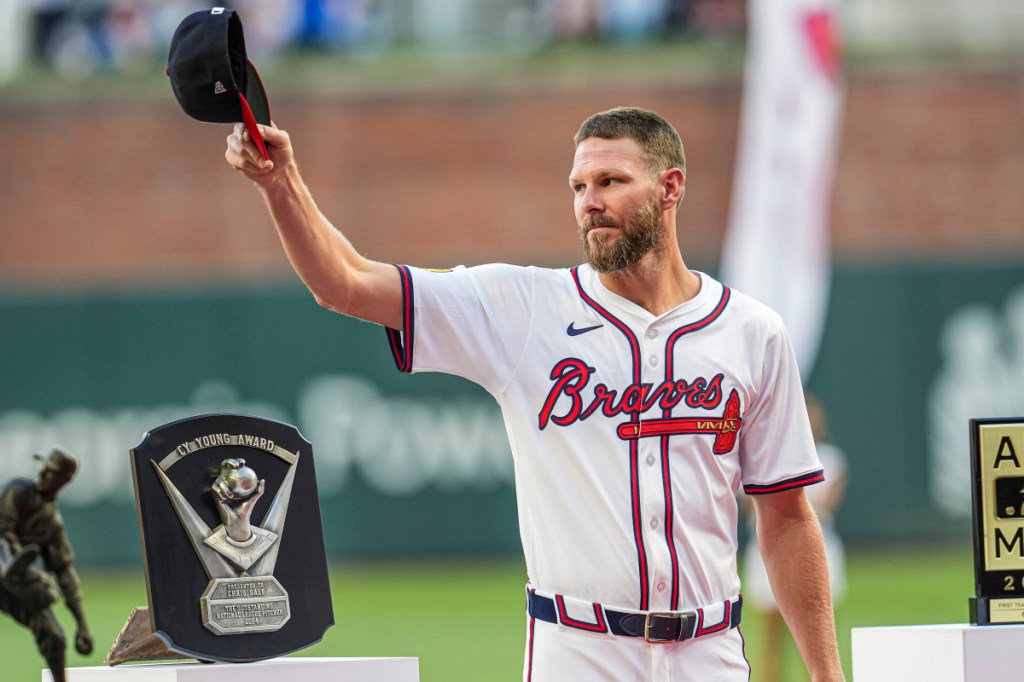
At age 35, Sale went 18-3 with a 2.38 ERA across 29 starts, striking out 225 hitters while posting a microscopic 1.01 WHIP. He led the National League in wins, ERA, and strikeouts to capture the Pitching Triple Crown, won the only Gold Glove of his career, earned First-Team All-MLB honors, and finally took home his first Cy Young Award. That last accomplishment still surprises me a little. For years, Sale always seemed to be in the Cy Young conversation. He was consistently one of baseball’s most dominant pitchers, yet somehow the award always found someone else. Seeing him finally add that trophy to his résumé felt less like a breakthrough and more like baseball correcting an oversight.
One of the more interesting things about Sale’s career is how often he’s described as injury-prone. On the surface, that label makes sense. Tommy John surgery, shoulder issues, rib fractures, and other setbacks have all become part of his story. But when you actually dig into the numbers, the narrative becomes much more nuanced.
Since becoming a full-time starter in 2012, Sale has made 20 or more starts in 12 of his previous 14 full seasons, excluding the COVID-shortened 2020 campaign in which he didn’t pitch because of Tommy John surgery. He’s already made 18 starts in 2026, which means he’ll almost certainly make it 13 out of 15. That’s actually remarkable durability for someone whose reputation has become so closely tied to injuries. The setbacks have been significant, but they’ve also tended to overshadow just how often Sale has been available to take the ball every fifth day.
Of course, none of this happens without the pitch that has defined his career.
Every generation seems to have a handful of pitchers who become synonymous with one devastating weapon. Mariano Rivera had the cutter. Trevor Hoffman built a Hall of Fame career around his devastating changeup. Barry Zito‘s curveball, Pedro Martínez‘s circle change. Clayton Kershaw‘s 12-to-6 curveball became one of the defining pitches of a generation, while Aroldis Chapman overwhelmed hitters with triple-digit velocity.
Chris Sale belongs in that same conversation because of one pitch: his slider.
For well over a decade, hitters have known it was coming and still struggled to do anything with it. Thrown from his low three-quarter arm slot, it begins on the same plane as his fastball before darting violently away from bats. Left-handed hitters have looked helpless against it for years, while right-handers have rarely fared much better. The pitch has become one of the defining weapons of modern baseball and, fittingly, draws comparisons to another lanky left-hander Sale admired growing up.
Sale has often spoken about idolizing Randy Johnson, even wearing No. 51 with the Atlanta Braves in tribute to “The Big Unit.” It’s easy to see the influence. Both stood on the mound with intimidating frames, attacked hitters with overpowering fastballs, and paired them with devastating sliders that often looked unhittable. Sale never tried to become Randy Johnson, but you can certainly see where the inspiration came from.
On a lighter note, anyone who grew up playing MLB The Show during the 2010s probably remembers exactly how unfair Chris Sale felt in that game. Whenever my friends and I loaded up a quick exhibition, whoever got Sale’s team instantly had an advantage. That slider was almost impossible to pick up, and I can personally attest that he was always the first pitcher selected in my house. Maybe that’s not exactly a Hall of Fame metric, but it certainly says something about how dominant he was during that stretch of his career.
Sometimes we become so focused on what’s next that we forget to appreciate what’s happening right in front of us. We spend countless hours debating prospects, projecting draft classes, and searching for baseball’s next superstar, while players like Chris Sale quietly continue adding milestones to careers that will one day be remembered among the greatest of their generation.
Ten All-Star selections. More than 2,700 strikeouts. A Cy Young Award. A Pitching Triple Crown. One of only ten pitchers ever to record 500 strikeouts with three different organizations. And before long, perhaps, another member of the 3,000-strikeout club.
That’s not simply the résumé of an excellent pitcher. It’s the résumé of one of the finest strikeout artists baseball has ever seen.
The next time Chris Sale takes the mound, it might be worth slowing down for a moment. Careers like this don’t come around very often, and baseball has a funny way of making us appreciate greatness a little more once it’s gone. I think Chris Sale has earned the recognition while he’s still writing his story.
 Empire Sports Talk
Leave a comment