
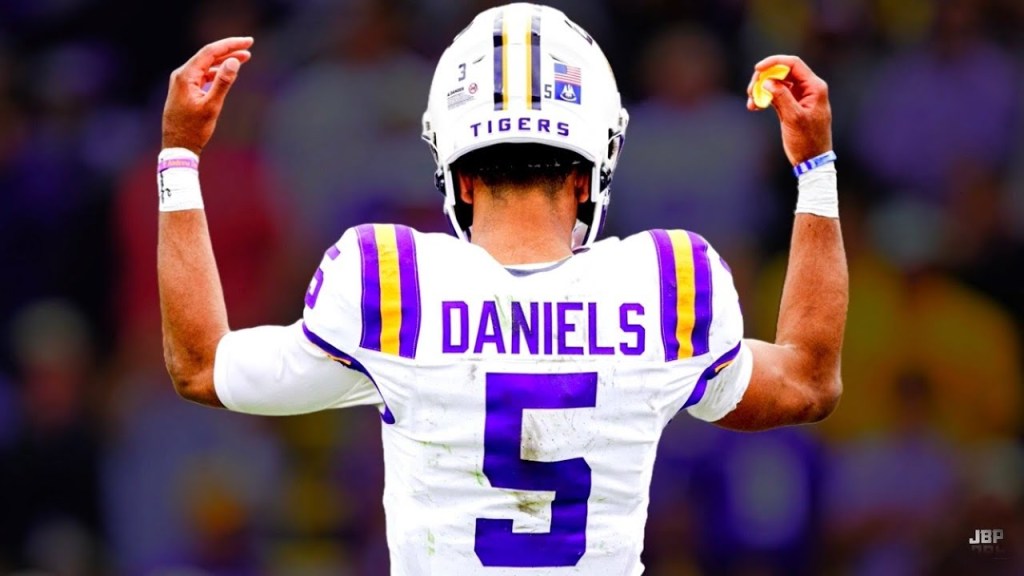
When I first saw the headline that Jayden Daniels had issued a cease-and-desist letter to LSU, my immediate reaction was pretty simple:
What in the world did LSU do to make Jayden Daniels this angry?
Daniels spent two seasons in Baton Rouge, resurrected his career after transferring from Arizona State, won the 2023 Heisman Trophy and turned himself into the No. 2 overall pick in the NFL Draft. Whatever had happened, I assumed LSU must have done something pretty significant for one of the greatest quarterbacks in program history to essentially tell the university to stop using his name, image and likeness.
Then I read what happened. LSU gave No. 5 to sophomore cornerback DJ Pickett.
That’s it. And after digging into the story, I somehow find myself firmly on LSU’s side.
According to reports, Daniels and his family feel “profoundly disrespected” that LSU allowed Pickett to wear the No. 5 that Daniels wore during his Heisman-winning career. Daniels’ representatives have now informed LSU that the university can no longer use his name, image or likeness. At the heart of the dispute is apparently Daniels’ belief that No. 5 should have continued receiving the same treatment LSU has given Joe Burrow‘s No. 9, which hasn’t been issued since Burrow left Baton Rouge after the 2019 national championship season.
I can give Daniels the tiniest amount of grace on one point: LSU had effectively established that expectation.
Former LSU coach Brian Kelly confirmed that No. 5 had intentionally been kept out of circulation after Daniels left. Kelly said Pickett had apparently been promised the number during his recruitment, but he wasn’t prepared to issue it without Daniels’ blessing because LSU had similarly protected Burrow’s No. 9. But Brian Kelly is gone. New head coach Lane Kiffin ultimately decided to honor the promise made to Pickett, as is his right to do so.
So, yes, I can understand Daniels being disappointed that something LSU had informally done to honor him changed. Disappointed? Sure. Cease-and-desist letter? Come on.
There’s a Pretty Big Joe Burrow Problem With This Argument
If Daniels wants his No. 5 treated like Joe Burrow’s No. 9, there’s one glaring problem:
Joe Burrow’s No. 9 isn’t retired either.
It has effectively been taken out of circulation since he left LSU, but the university has not formally retired it. More importantly, LSU has an established process governing these things.
According to LSU’s own jersey-retirement bylaws, a former athlete must be at least five years removed from his or her LSU career before even becoming eligible for nomination. The player’s accomplishments must be considered truly unusual and outstanding, the honor is supposed to consider the athlete’s total LSU career, and a nomination requires unanimous support from the Hall of Fame committee. Even after a modern LSU jersey is retired, the school’s post-2007 rules generally allow another athlete to wear that number at the head coach’s discretion.
Daniels finished his LSU career in 2023. In other words, we’re arguing about why LSU hasn’t given him an honor that, under LSU’s own rules, he isn’t even eligible to receive yet.
And if there’s one recent LSU player for whom I’d be willing to bend the rules, it isn’t Daniels.
It’s Joe Burrow (who coincidentally has now been away from LSU for more than 5 years, therefore opening up his eligibility).
Burrow didn’t merely win the Heisman Trophy. He authored one of the greatest quarterback seasons college football has ever seen while leading the 2019 Tigers to a 15-0 national championship season. That team also has a legitimate argument as one of the greatest college football teams ever assembled.
If we’re going to start permanently removing numbers because of one transcendent season, Burrow’s No. 9 should be first in line. Yet No. 9 still isn’t officially retired. I don’t hear Joe Burrow threatening LSU with attorneys.
College Football Is Full of Legends Whose Numbers Aren’t Retired
Zoom out from Baton Rouge for a moment, because this is where Daniels’ complaint becomes even harder for me to understand.
Jersey retirement in college football isn’t remotely as common as it is in professional sports, partly because the history of these programs is so long. When you’ve played football for more than a century and dress massive rosters every fall, you can’t simply remove a number every time a great player comes through town.
Look at Tim Tebow.
If there were ever a modern college football player whose résumé screamed for permanent immortality, it’s Tebow. Two national championships. A 2008 BCS National Championship Game MVP. The 2007 Heisman Trophy. Two SEC Male Athlete of the Year awards. One of the most recognizable and beloved players in the history of the sport.
No. 15 isn’t retired at Florida. In fact, Florida doesn’t retire football numbers at all. Tebow is instead immortalized in the program’s Ring of Honor.
Alabama doesn’t traditionally retire football numbers either. Think about how ridiculous that list could become if they did. Derrick Henry. DeVonta Smith. Bryce Young. Mark Ingram. Tua Tagovailoa – and those are just the RECENT names. That doesn’t even account for the decades of Crimson Tide history. Joe Namath anyone? One of the most recognizable names in the history of football, college or pro. Yet his #12 is still available and worn in Tuscaloosa.
A.J. McCarron won back-to-back BCS National Championships as Alabama’s starting quarterback and finished his career as one of the most accomplished quarterbacks in the history of one of college football’s most accomplished programs.
No. 10 is still available.
Johnny Manziel‘s No. 2 isn’t retired at Texas A&M. Whatever you think about everything that followed, Johnny Football electrified college football, won the Heisman (very nearly becoming the second player ever to win two) and helped catapult Texas A&M into national relevance immediately after the Aggies entered the SEC. No. 2 is still being worn in College Station today.
Andrew Luck‘s No. 12 isn’t retired at Stanford either, and Luck is now back at the university serving as the football program’s general manager.
These aren’t fringe players. These are some of the defining figures of modern college football.
So if those players can see their numbers remain available, I have a hard time accepting the premise that LSU somehow disrespected Jayden Daniels by allowing another talented young player to wear No. 5.
Then There’s Caleb Williams
There is, however, one obvious contemporary comparison that I suspect hangs over this entire conversation: Caleb Williams.
USC retired Williams’ No. 13 after his two seasons with the Trojans because USC has a longstanding tradition of retiring the numbers of its Heisman Trophy winners. When Reggie Bush‘s Heisman was reinstated, USC restored his No. 5 alongside Williams’ No. 13, meaning all eight USC Heisman winners were once again represented among the school’s retired numbers.
I’ve never particularly loved that policy.
That’s not because Caleb Williams didn’t deserve the 2022 Heisman Trophy. He absolutely did. He was spectacular. But there’s a difference between saying someone was the best player in college football for one season and saying that his impact on a university was so enormous that no one should ever wear his number again.
Williams played two seasons at USC. The first was brilliant. The second ended with five regular-season losses. By comparison, A.J. McCarron lost four games during his entire career at Alabama. Those aren’t comparable collegiate legacies.
The fact that Williams’ No. 13 went up alongside the restored No. 5 of Reggie Bush made the contrast even stranger to me. Bush spent three seasons at USC, became one of the most electrifying players college football has ever seen, helped build a dynasty and became synonymous with an era of Trojan football.
Williams won a Heisman. Both are tremendous accomplishments. They aren’t the same legacy. USC’s policy dictates otherwise, and that’s USC’s prerogative. But LSU doesn’t have that policy.
That’s the important part. Jayden Daniels doesn’t get to apply USC’s standards to LSU because another quarterback from his draft class received an honor he hasn’t.
Williams and Daniels are inevitably going to be compared. They won consecutive Heismans. They became the first two selections of the 2024 NFL Draft. Their professional careers will probably be measured against one another for years.
I can understand how seeing Williams’ No. 13 retired might create a little chip on Daniels’ shoulder. But that doesn’t make No. 5 his property.
That Number Isn’t Yours
This is where I lose Daniels completely. You don’t own No. 5 at LSU. You wore it. You represented it extraordinarily well. You won a Heisman wearing it. You created memories in it that LSU fans will remember for the rest of their lives. One day, your jersey may very well receive the formal recognition that accompanies those accomplishments.
But it is still LSU’s No. 5. And the decision regarding how LSU honors its history belongs to LSU.
Whatever happen to the saying, “The name on the front of the jersey is more important than the name on the back?” Pickett isn’t wearing a jersey that says “DANIELS” across the back. LSU isn’t pretending Daniels’ accomplishments didn’t happen. Nobody is erasing the 2023 Heisman Trophy from the record books. The university simply decided that another player could wear the same number. That’s college football.
Frankly, there’s an opportunity here that I think would have been far more meaningful.
Imagine Daniels publicly embracing Pickett. Imagine him telling the young cornerback, “If you’re going to wear 5, make it mean something.” Suddenly, instead of No. 5 belonging to one player forever, it becomes a tradition. Maybe LSU’s next great player wears it, and then another one after him.
We’ve seen programs turn numbers into honors rather than remove them entirely. LSU themselves uses #7 and #18 as jersey numbers based on tradition. Ole Miss honors the defensive player who most embodies courage and perseverance by awarding them #38. Nebraska holds a team vote for the number 1, given to the player who most represents the core values of Nebraska football. These are cases of tradition and honor mattering more than personal gain.
That could have added to Daniels’ LSU legacy. Instead, attorneys got involved.
NIL Has Changed More Than the Bank Accounts
This is where the story connects to something I’ve increasingly struggled with in modern college athletics.
I support players having the ability to benefit financially from their name, image and likeness. The old system had obvious problems. Universities, conferences, television networks and apparel companies were making enormous amounts of money while the athletes creating the product faced strict limitations on what they could earn.
But NIL and the transfer portal haven’t just changed compensation. They’ve changed the relationship between athletes and universities.
There used to be something romantic about college sports that professional sports couldn’t replicate. Wearing Alabama crimson, Michigan maize and blue, Notre Dame gold or LSU purple and gold was supposed to mean something beyond a transaction.
Nick Saban has talked repeatedly about the dangers of recruiting becoming purely transactional, including the now-famous story of telling a recruit looking for a massive NIL guarantee before arriving on campus that he could find somewhere else to play.
The principle behind that story has always resonated with me: earn it.
College athletes increasingly want to be treated like professionals. Fair enough. College football effectively is professional sports now.
But professionalism can’t only apply when the check clears. Being a professional also means understanding that organizations make decisions you won’t always like. It means handling disappointment without immediately turning every disagreement into a public feud. It means understanding that respect isn’t always synonymous with getting what you want.
That’s why this reaction bothers me so much.
LSU Didn’t Disrespect Jayden Daniels
LSU gave Jayden Daniels an opportunity after Arizona State. Daniels rewarded that opportunity by producing one of the greatest seasons in school history. LSU gave him a platform, and Daniels elevated the program while using that platform to turn himself into a Heisman winner and elite NFL prospect.
That relationship should be celebrated by both sides. Instead, because another player was given No. 5, Daniels’ representatives have effectively told the university to stop using his connection to them.
Legally, he may have every right to do it. Reporting indicates LSU’s contractual right to use Daniels’ NIL expired after his college career, so this isn’t really a question of whether Daniels can demand that LSU stop. It’s whether this was the right way to respond.
For me, it wasn’t.
If Daniels was disappointed, call the athletic director. Talk to Lane Kiffin. Ask why the decision was made. Express that you thought the number was going to remain out of circulation. Have the conversation. Instead, this comes across like taking your ball and going home.
Maybe there are conversations behind the scenes that we don’t know about, and if more information emerges, I’m perfectly willing to reassess that part of this story. Based on what has been reported so far, however, I think this is a massive overreaction. And ironically, it may make the thing Daniels apparently wants even more difficult.
LSU’s jersey-retirement process requires unanimous approval from its Hall of Fame committee. Self-nominations aren’t even considered. Daniels isn’t eligible yet anyway. Going to war with the university over the number probably isn’t the greatest campaign strategy.
Let the Legacy Speak for Itself
Jayden Daniels doesn’t need No. 5 permanently removed from LSU football to validate what he accomplished. The Heisman Trophy isn’t going anywhere. The highlights aren’t going anywhere. The record books aren’t going anywhere. LSU fans aren’t suddenly going to forget 2023 because DJ Pickett runs onto the field wearing No. 5.
Daniels earned his place in LSU history. Eventually, perhaps the university will formally retire his jersey. Based on the school’s criteria, a Heisman winner certainly has a strong case once he becomes eligible. But honors mean more when they’re given than when they’re demanded. That’s ultimately my biggest problem with this entire situation.
There is a difference between believing you deserve recognition and acting as though you’re entitled to dictate how an institution recognizes you. Jayden Daniels was an incredible LSU Tiger. He deserves to be celebrated as one.
He doesn’t deserve ownership of the number 5. And if Tim Tebow can watch another Florida Gator wear No. 15, if A.J. McCarron can watch another Alabama player wear No. 10, if Johnny Manziel can see No. 2 continue circulating through Texas A&M and Joe Burrow himself can wait patiently while LSU determines the future of No. 9, then I think Jayden Daniels can survive seeing another LSU Tiger wear No. 5. Especially when, under LSU’s own rules, the conversation about formally retiring his jersey can’t even begin yet.
The number doesn’t create the legacy. What you did while wearing it does. And for Daniels, his latest actions may have irrevocably tarnished that legacy.
 Empire Sports Talk
Leave a comment