
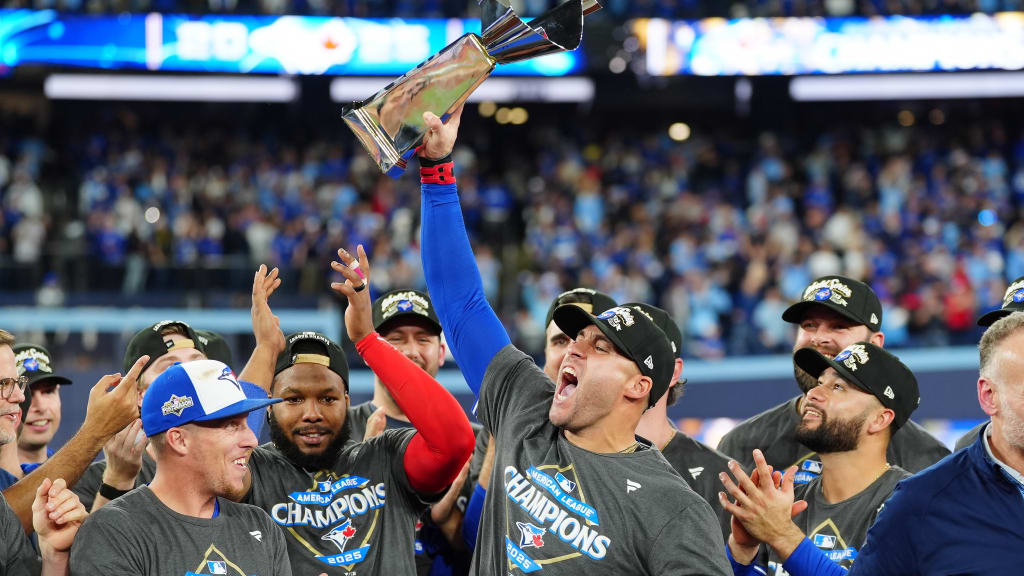
Built to Finish the Job
If you’re still treating the Toronto Blue Jays like “just another playoff team,” you didn’t watch October.
Toronto didn’t just make a postseason run in 2025 — they went toe-to-toe with the Los Angeles Dodgers in the World Series and came within a swing or two of bringing a title north of the border. That matters. It changes expectations. It changes urgency. And it changes how every roster decision should be evaluated.
This is no longer a team hoping to break through. This is a team trying to finish the job.
2025 Review: A Legitimate Championship Team
Toronto’s 2025 club was built on balance, depth, and resilience — not just star power.
Offensively, the Jays finished top-5 in runs scored and OPS, thriving on lineup length rather than relying on one or two superstars. George Springer’s postseason return proved massive, providing leadership, clutch production, and tone-setting at-bats when the lights were brightest. Something he’s been known for at the top of postseason lineup cards for years. Guerrero Jr. continued anchoring the lineup, while the supporting cast consistently delivered professional at-bats that wore down opposing pitching staffs.
But the biggest storyline — and the one that shifted Toronto’s ceiling entirely — was the emergence of Trey Yesavage.
Yesavage didn’t just contribute. He announced himself as a future ace.
The rookie flamethrower brought swing-and-miss stuff, poise beyond his years, and postseason composure that changed how opponents approached Toronto’s rotation. By October, he wasn’t just another arm — he was a legitimate frontline presence capable of matching elite playoff starters pitch for pitch. If you’re projecting the next wave of MLB pitching stars, Yesavage is already firmly in that conversation.
Toronto’s pitching staff finished among the league’s best in strikeout rate, and that foundation carried them through three playoff rounds before ultimately falling just short against a historically deep Dodgers roster.
This wasn’t a fluke run. This was a team proving it belongs on the sport’s biggest stage.
A Roster That Didn’t Stand Still
Rather than running it back, Toronto aggressively reshaped key areas of the roster.
The headline departure was Bo Bichette, marking the end of a long-standing infield core. Bichette’s bat, leadership, and identity were foundational to this era of Blue Jays baseball — but his exit also created payroll flexibility and lineup recalibration opportunities.
This wasn’t subtraction without purpose. It was a strategic pivot.
If you’re serious about winning championships, you stockpile frontline pitching.
Adding Dylan Cease gives Toronto one of the most intimidating rotation pairings in baseball alongside Yesavage. Cease brings power stuff, postseason experience, and durability — the exact type of arm that shortens playoff series and neutralizes elite offenses. This also addresses one of Tronto’s weaknesses, as they were in the bottom half of the league in team ERA.
I do think the Jays will miss Chris Bassitt‘s ability to reliably eat innings during the regular season, but few teams can now match Toronto pitch-for-pitch in October.
After narrowly missing out on getting Kyle Tucker, the signing of Eloy Jiménez adds a different dimension to the lineup — legitimate middle-of-the-order thunder capable of changing games with one swing. While durability will always be part of the conversation with Jiménez, his upside as a run producer gives Toronto more margin for error offensively and helps offset Bichette’s departure. Additionally, after a disappointing first year of a 5-year $92.5 million contract from Anthony Santander, where he hit just .175 with 6 home runs and 18 RBIs in just 54 games, Jimenez offers some offensive insurance from a corner outfield position, should Santander not bounce back in year two. If he does, the Jays will have a choice to make, but regardless, they will have slugging depth.
This lineup is deeper, more dangerous, and harder to navigate.
Biggest Questions Entering 2026
🔹 Can Trey Yesavage Sustain Ace-Level Production?
The talent is obvious. The stuff is real. The postseason performance backed it up. The next step is durability and consistency across a full season workload. If Yesavage holds, Toronto’s championship window widens dramatically.
🔹 How Does the Lineup Replace Bichette’s Stability?
While Jiménez adds power, the everyday consistency Bichette provided at shortstop and near the top of the order must be replaced internally or structurally. Run prevention and defensive reliability up the middle will matter more than raw slugging.
🔹 Can They Stay Healthy in the Middle of the Order?
Jiménez, Springer, and several core pieces carry varying durability risk. Depth matters — especially for a team that expects to play deep into October again.
Have They Addressed Their Needs?
Yes — and aggressively. When you’ve proven you can go toe-to-toe with a juggernaut like the Dodgers, you have to add the way the Dodgers do (or at least try your best.
✔ Added a legitimate frontline starter (Cease)
✔ Added middle-of-order power (Jiménez)
✔ Elevated an emerging ace (Yesavage)
✔ Created payroll flexibility post-Bichette
Toronto didn’t sit on its success. They leaned into it.
Our Take
The Blue Jays are no longer chasing legitimacy — they already earned it in October.
This roster is deeper, more dangerous on the mound, and more structurally flexible than last year’s pennant winner. The combination of Cease and Yesavage gives Toronto a playoff rotation that can go punch-for-punch with anyone in baseball. The offense still has thump, experience, and postseason DNA.
If anything holds them back, it won’t be talent — it’ll be health, defensive consistency, and how well they absorb the loss of Bichette’s steady presence.
But make no mistake: Toronto enters 2026 as a legitimate championship threat, not just a contender.
And after coming that close to knocking off the Dodgers? You better believe they’re hungry.
 Empire Sports Talk
Leave a comment