
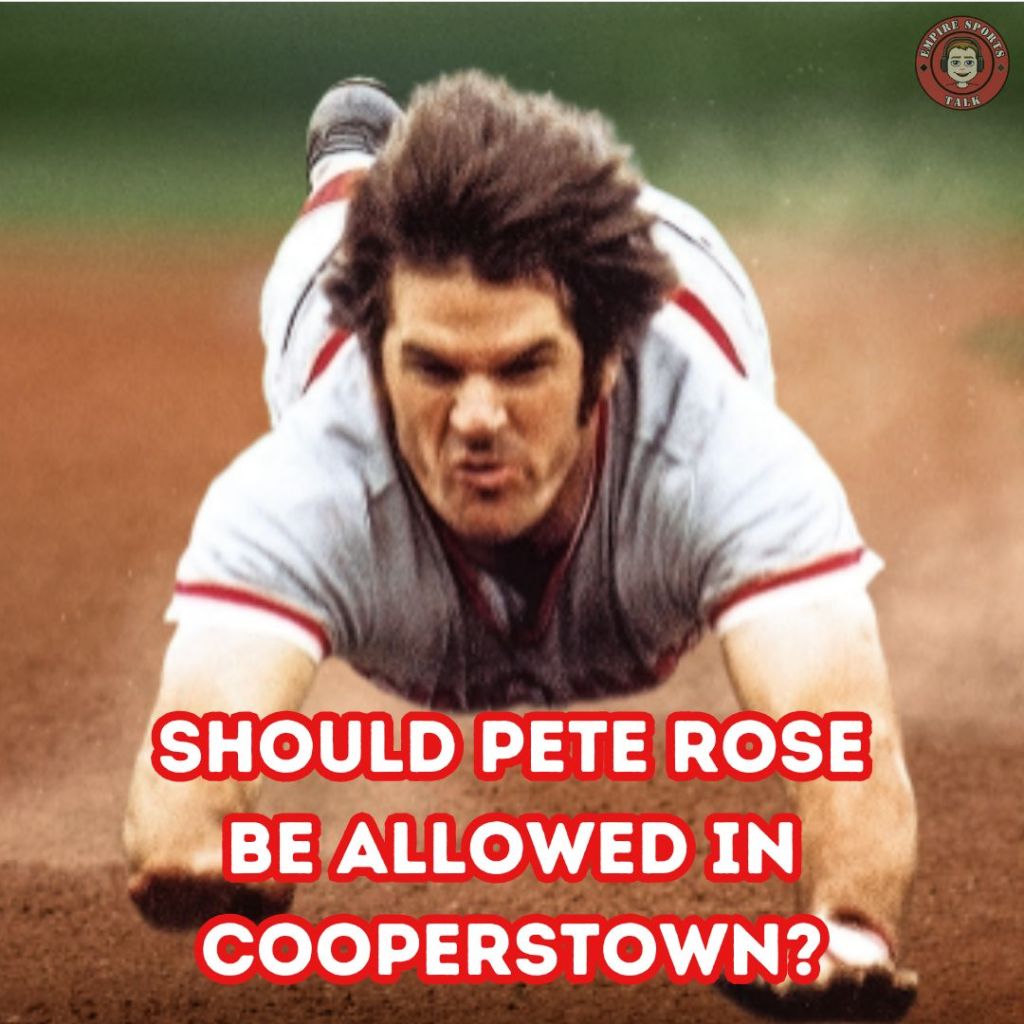
Pete Rose – a name that conjures up a lot of feelings among baseball fans. Baseball’s all-time hits leader, an MVP, an eccentric personality, a passionate fan, and infamously banned from baseball. Love him or hate him, Rose was a giant in this great game in more ways than one. Pete Rose died on Monday at the age of 83, without ever seeing his plaque enshrined in Cooperstown.
It’s a tough topic of conversation to bring up Rose’s name because the word Cooperstown is never far behind. Both sides of the debate certainly have merit. On one hand, Pete Rose is the all-time leader in hits, singles, games played, plate appearances, and at-bats. He’s a 17-time All-Star, 3-time World Series champion, 3-time batting champion, 2-time Gold Glove Award winner, 1973 NL MVP, 1975 World Series MVP, and believe it or not, there’s more. Rose has a great a resume as anyone in the Hall. On the other hand, he was banned for life from baseball in 1989 for betting on games while he was playing and managing games in Major League Baseball.
Therein lies the rub – the significant rub. In 2004, Rose admitted that he had bet on baseball and on the Cincinnati Reds. In 1989, lawyer John M. Dowd was retained by the league to investigate the charges against Rose. Although Dowd has stated that he believes Rose had bet against the Reds while managing them, the “Dowd Report” concluded that “no evidence was discovered that Rose bet against the Reds.”
This is the tricky part as far as I’m concerned. There is evidence that Pete Rose placed bets on the Reds in his career, but no evidence that any of those bets were against his team. Most of the players we talk about in Major American sports who have received similar bans have placed bets against their teams. Take the NBA’s Jontay Porter for example. On April 17, 2024, Jontay Porter was banned for life from the NBA for gambling. In Porter’s case there was evidence that he bet against his own team, often taking “under bets.” He also disclosed confidential injury information about himself and teammates, even going as far as removing himself from a game due to illness – a move that drew suspicion from the league.
This is where we can draw a line in the sand from the Pete Rose situation. Porter intentionally played below his ability, disclosed confidential information, and removed himself from games, actively hindering the performance of the team he played on in service of lining his own pockets. As I mentioned, the “Dowd Report” found no evidence that Rose bet against the Reds. As far as we know, Rose only bet in favor of his team.

Think outside of the box with me for a second: Pete Rose is the all-time leader in hits, a three-time World Series champion and a World Series MVP. His nickname was Charlie Hustle. Does that sound like someone who was betting against his own team? Pete Rose never pulled any punches on the field. He gave everything he had every time he stepped between those lines. In his 2020 petition for reinstatement, Rose stated that his gambling “did not affect the outcome of games, whereas other players who used steroids or used electronic signs to steal catchers’ signals, did affect games, yet were not banned.”
As far as Rose’s managerial tenure with the Reds, Hal McCoy, a beat writer covering the Reds for the Dayton Daily News stated that “the major problem with Rose betting on baseball, particularly the Reds, is that as manager he could control games, make decisions that could enhance his chances of winning his bets, thus jeopardizing the integrity of the game.” Rose managed the Reds from 1984-89 with a career managerial record of 426–388 (.523), a record which was good enough to make Rose the 5th-winningest manager in Reds history. While he never led the Reds to the playoffs, his teams were competitive. Until we have proof that Rose bet against the Reds, his passion and competitive nature make it hard for me to believe he would. Charlie Hustle was a winner.
Now, I get it, the letter of the law in Major League baseball is clear:
Rule 21 Misconduct, (d) Betting on Ball Games, Any player, umpire, or club, or league official, or employee, who shall bet any sum whatsoever upon any baseball game in connection with which the bettor has a duty to perform shall be declared permanently ineligible.
With that being said, since there is no proof that any of Rose’s wagers were against the city he called home, we have to assume that he was betting on his team to win – and isn’t that what every player and coach on every team does each time that he suits up on game day? The only difference is, for Rose, there was money involved. I’m not necessarily saying that it should be okay to bet on games you’re playing in as long as you bet on your team to win, but what I am saying is that there is a clear competitive difference between what Rose did and what Jontay Porter did.
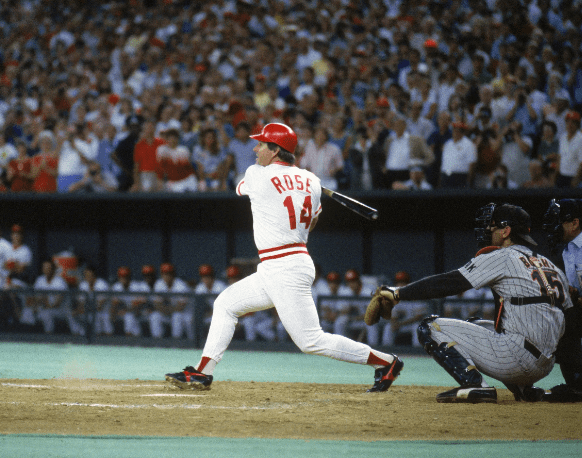
The reason that rules like this are in place is to protect the integrity of the game, and I’d argue that Pete Rose played, hustled and loved this game harder than anyone who’s ever worn a uniform. He played more games than anyone, took more at-bats, tallied more hits, then immediately became a manger. Pete Rose didn’t want to take off the uniform, he couldn’t leave the game he loved behind. How is that harmful to the integrity of this game.
Upon hearing the news of Rose’s passing, Bob Costas shared a story about walking through the Hall of Fame with Rose, and when they got to the Plaque Gallery, where Rose’s image is famously absent, Costas walked with him right up to Ty Cobb’s plaque. Rose passed Cobb to become baseball’s all-time hit leader on September 11, 1985. Costas recalled that Rose stared up at Cobb’s plaque in reverence, almost as if to say, “Why can’t I be here?” Even though the laundry list of answers to that question stem from Rose’s own actions, it paints the picture of a man that never loved anything more than the game he gave his life to and wanted more than anything to be welcomed back with open arms. Pete never turned his back on the game, even though the gamed turned its back on him. In 32 years, I never saw Pete Rose make a public appearance without wearing a Cincinnati Reds cap.

Pete Rose’s ban from baseball has been a major point of discussion among fans for decades, but after sports betting became legal in 2018, the debate took on new life. As a player, Rose played with passion and fervor. It’s not hyperbolic to say that, as a player, Pete Rose is one of the most beloved players in league history, even by fans who never got to see him play.
While I understand the reasons for why we may never see Rose in the Hall of Fame, it stings to know that he won’t get to see it either. To paraphrase Pete’s own words from his 2020 appeal, other players over the years have cheated the game by used performance-enhancing substances, or stealing signs with electronic devices and trash cans who have not received bans, or in some cases, punishments of any kind. Those players betrayed the integrity of the game far more than Rose ever did.
Pete Rose’s 2004 memoir was titled “My Prison Without Bars.” Well, Pete on September 30th, you were paroled. Maybe one day, you’ll be pardoned. I’m sorry you won’t be here to see it.
 Empire Sports Talk
Leave a comment